Scholarship Applications: What Every Student Needs to Know
Tackling a scholarship application often feels overwhelming, confusing, or even a little intimidating at first. The sheer number of steps involved can leave anyone feeling a bit lost early on. But here’s the truth: once you understand the process, applying for scholarships becomes a repeatable, manageable skill.
What follows breaks down each part of the process — from the very first step to the final follow-up — equipping you to submit stronger applications and increase your real odds of success.
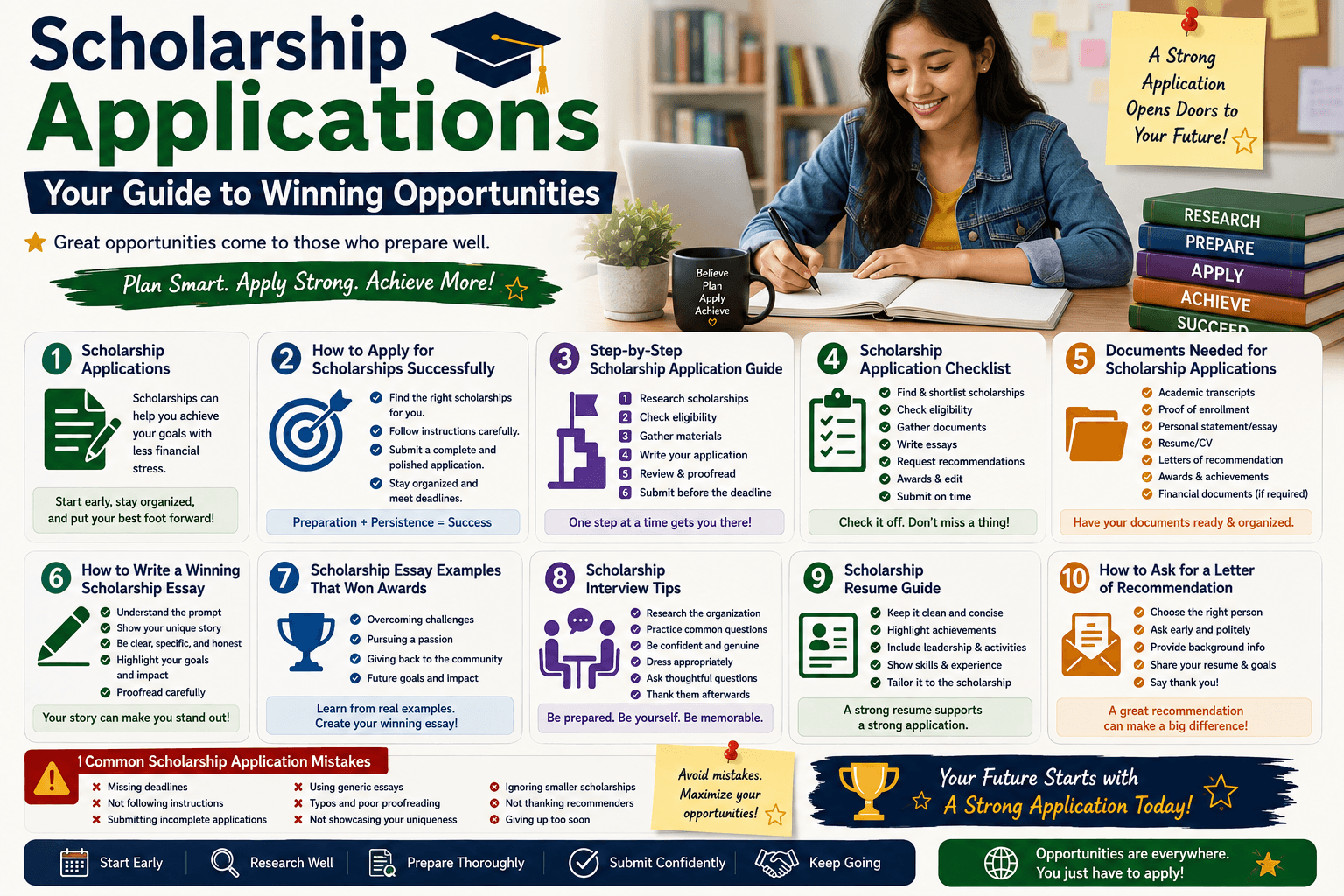
How to Apply for Scholarships Successfully
Success with scholarship applications rarely comes down to luck — it’s really about careful preparation, precision, and a smart, targeted approach. The students who win the most scholarships aren’t necessarily the smartest — more often, they’re simply the ones who apply widely and follow every guideline precisely.
A handful of consistent habits tend to define the most successful candidates:
Begin well ahead of deadlines — scholarship committees can usually tell when an essay was written the night before.
Study the guidelines closely — overlooking something minor, like formatting rules, can knock out an application that would’ve otherwise been competitive.
Customize every submission — generic, copy-pasted answers are easy for reviewers to spot.
Submit to many programs at once — the more programs you apply to, especially lesser-known local ones, the better your chances.
Step-by-Step Scholarship Application Guide
This straightforward sequence works for almost every scholarship program you’ll encounter:
Research and shortlist — compile scholarships you qualify for, focusing on those aligned with your interests, major, or personal story.
Confirm eligibility and timing — write down every requirement and deadline, then organize them somewhere easy to check.
Gather your documents — transcripts, recommendation letters, financial forms, and anything else the application asks for.
Draft your essay or personal statement — give yourself enough time to write multiple drafts, not just one rushed version.
Request recommendation letters — reach out well in advance, giving your references weeks rather than days.
Edit and double-check your materials — look closely for grammar mistakes, formatting problems, and whether your essay truly addresses the question.
Send it in early, not at the last second — don’t wait until the final hour — technical glitches happen more often than you’d think.
Send a thank-you note when relevant — a short thank-you note to recommenders or interviewers leaves a lasting positive impression.
Scholarship Application Checklist
A last-minute scan through this list can save you from costly mistakes:
Have you met every eligibility requirement?
Are every one of the requested files actually included?
Has anyone besides you checked your essay for errors?
Have your references actually turned in their letters?
Did you double-check the technical specs, like word limits and accepted file types?
Have you confirmed your email and phone number are current?
Are you turning this in with room to spare, not at the last second?
Documents Needed for Scholarship Applications
While requirements vary, a familiar set of documents tends to reappear across applications:
Academic transcripts — documentation verifying your classes and performance record.
Personal statement — your chance to explain your goals, story, or why you deserve the award.
Endorsement letters — typically from an educator, supervisor, or mentor familiar with your strengths.
List of achievements and activities — a summary of your academic, extracurricular, work, and volunteer experience.
Admission confirmation — confirming you’re enrolled in, or accepted to, an eligible school or program.
Financial need documentation — tax returns, income statements, or aid forms like the FAFSA, when required.
How to Write a Winning Scholarship Essay
Among everything you submit, the essay tends to matter most — it’s where your personality and story come through, not just your GPA.
What Makes an Essay Actually Win
Strong scholarship essays tend to share a few key traits:
One vivid, specific example — instead of vague statements like “I’ve always worked hard,” describe a specific moment that proves it.
Honesty over impressiveness — judges have seen every cliché in the book, so genuine voice stands out.
A direct link to your future plans — explain not just what happened to you, but how it shapes where you’re headed.
Careful editing — even a compelling essay loses credibility with sloppy errors.
Scholarship Essay Examples That Won Awards
While every winning essay is different, most successful ones follow a similar structure: they hook the reader immediately with something specific and real. The essay then ties that moment to a broader insight, value, or personal shift. Finally, they tie everything back to the applicant’s future goals and why the scholarship matters.
Common winning topics include overcoming a specific challenge, a formative experience with a mentor, a moment that shifted a career goal, or a personal responsibility that shaped the applicant’s character. The subject matters less than how genuinely and specifically it’s told.
Scholarship Interview Tips
Some scholarships include an interview stage, and for those, getting ready properly is crucial.
Know your own application — be ready to speak in detail about your essay, activities, and goals, since interviewers often ask follow-up questions.
Rehearse likely prompts — typical questions revolve around your goals, motivations, and reasons for applying.
Treat it like a real interview — even a virtual interview deserves the same level of preparation as an in-person one.
Show curiosity about the program — thoughtful questions demonstrate that you’ve actually researched the organization.
Scholarship Resume Guide
Scholarship resumes follow slightly different rules than typical job-application resumes — it centers on academic and community contributions instead of formal employment.
Structure it cleanly, aim for a single page, and use clearly labeled sections for academics, extracurricular activities, volunteer work, awards, and skills. Lead with active language and include numbers whenever you can — precision in both language and figures makes a resume far more convincing.
How to Ask for a Letter of Recommendation
Requesting a reference doesn’t have to be stressful if you handle it thoughtfully.
Ask early — a month’s notice, if possible, respects their schedule and results in a stronger letter.
Ask the right person — a person who genuinely knows your work, not simply the most senior name you can think of.
Give them useful material to work with — send your resume, the scholarship description, and a few points you’d love them to mention.
Check in respectfully as the deadline nears — a brief, courteous reminder a week before the deadline is completely appropriate.
Express genuine appreciation — regardless of the outcome, a thank-you note is simply good etiquette.
Common Scholarship Application Mistakes
Plenty of qualified applicants get passed over for entirely preventable reasons. Here are the mistakes that show up again and again:
Submitting late — late applications are almost always rejected outright, no exceptions.
Overlooking specific guidelines — failing to follow exact formatting or content rules often results in automatic rejection.
Submitting a one-size-fits-all response — a recycled essay rarely resonates the way a customized one does.
Asking recommenders at the last minute — last-minute requests often result in generic, unenthusiastic letters.
Poor proofreading — a single unedited draft rarely represents your best possible work.
Applying too narrowly — focusing only on large, highly competitive national awards while ignoring smaller local ones with better odds.
The Bottom Line for Beginners
If there’s one lesson to take from this guide, it’s that scholarship applications reward preparation, not perfection. Start early, follow instructions exactly, tell a genuine and specific story in your essay, and apply to as many legitimate opportunities as you reasonably can. Winning scholarships often comes down to persistence and effort as much as raw qualifications.