Scholarship Applications: What Every Student Needs to Know
Sitting down to complete a scholarship application can seem far more complicated than it actually needs to be. The sheer number of steps involved can leave anyone feeling a bit lost early on. Here’s the good news, though: breaking the process into clear steps turns something intimidating into something completely doable.
What follows breaks down each part of the process — from the very first step to the final follow-up — giving you the confidence and strategy needed to genuinely boost your chances.
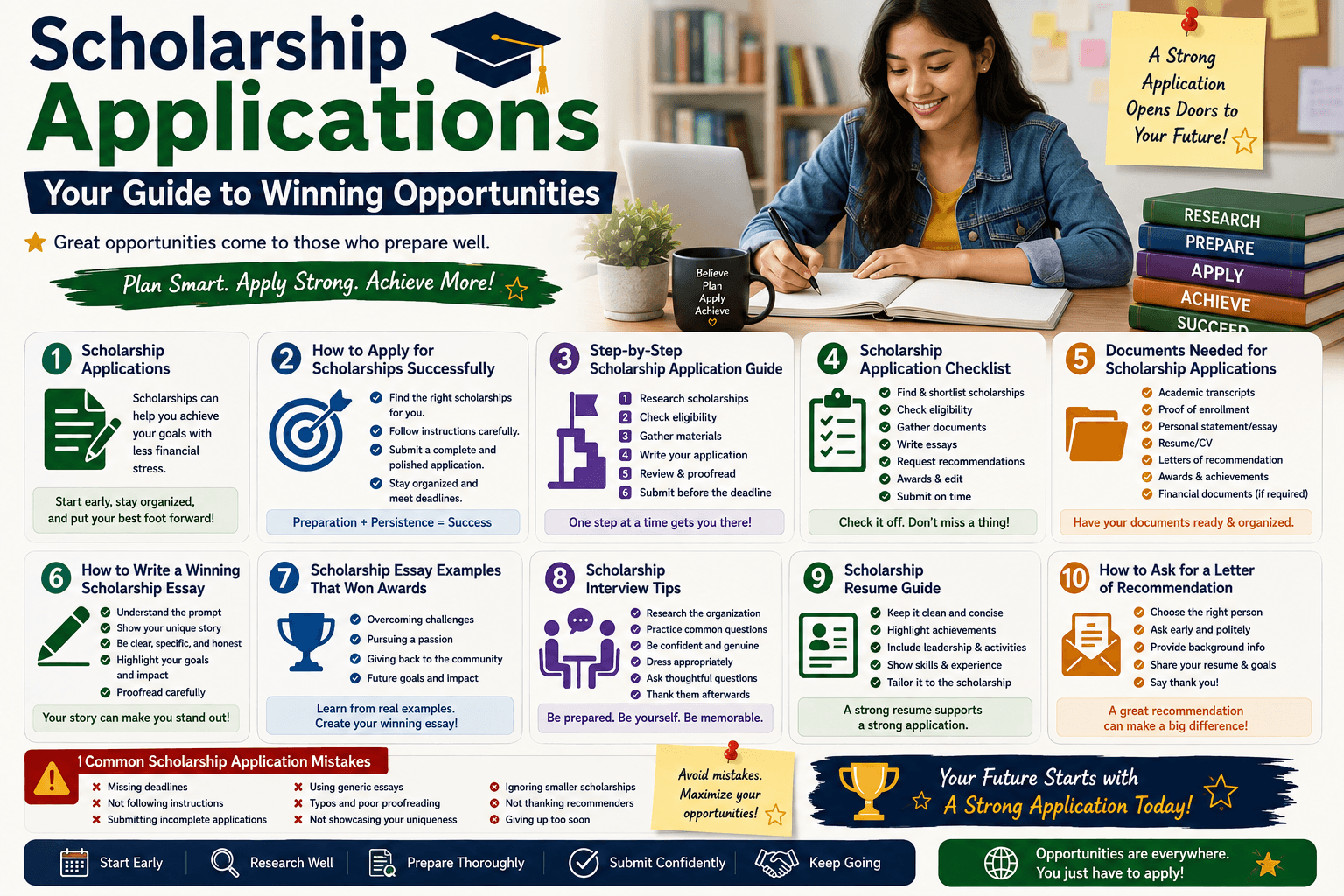
How to Apply for Scholarships Successfully
Success with scholarship applications rarely comes down to luck — it comes down to preparation, attention to detail, and applying strategically. The students who rack up the most scholarship wins aren’t always the top academic performers — they’re usually the ones who apply to the most opportunities and follow instructions carefully.
A handful of consistent habits tend to define the most successful candidates:
Get going long before due dates — scholarship committees can usually tell when an essay was written the night before.
Pay close attention to every instruction — missing a small detail, like a word count or file format, can disqualify an otherwise strong application.
Personalize each application specifically — recycled, one-size-fits-all responses tend to stand out for the wrong reasons.
Submit to many programs at once — the more programs you apply to, especially lesser-known local ones, the better your chances.
Step-by-Step Scholarship Application Guide
Use this basic roadmap for virtually any scholarship you apply to:
Research and shortlist — build a list of eligible opportunities, weighting it toward programs that genuinely fit who you are.
Review criteria and due dates — write down every requirement and deadline, then organize them somewhere easy to check.
Collect required paperwork — transcripts, recommendation letters, financial forms, and anything else the application asks for.
Draft your essay or personal statement — budget real time for redrafting instead of submitting your first version.
Secure your endorsements — reach out well in advance, giving your references weeks rather than days.
Polish the entire application — look closely for grammar mistakes, formatting problems, and whether your essay truly addresses the question.
Send it in early, not at the last second — aim to submit at least a day or two early in case of technical issues.
Send a thank-you note when relevant — a brief message of appreciation to anyone who helped you goes a long way.
Scholarship Application Checklist
A last-minute scan through this list can save you from costly mistakes:
Does your profile match all listed eligibility rules?
Have all required documents been uploaded or attached?
Has your essay been proofread by someone other than yourself?
Are your recommendation letters submitted or confirmed?
Did you double-check the technical specs, like word limits and accepted file types?
Have you confirmed your email and phone number are current?
Did you leave yourself cushion time before the true cutoff?
Documents Needed for Scholarship Applications
While requirements vary, a familiar set of documents tends to reappear across applications:
School transcripts — documentation verifying your classes and performance record.
Personal statement — the section where you make your case — your background, ambitions, and motivations.
Letters of recommendation — provided by someone who can speak credibly to your character and abilities.
CV or extracurricular summary — a summary of your academic, extracurricular, work, and volunteer experience.
Enrollment verification — documentation proving your admission or attendance at an approved school.
Financial documents (if need-based) — paperwork proving household income, typically required only for need-based awards.
How to Write a Winning Scholarship Essay
Among everything you submit, the essay tends to matter most — it’s your chance to stand out beyond grades and test scores.
What Makes an Essay Actually Win
The most successful essays consistently follow a similar pattern:
One vivid, specific example — instead of vague statements like “I’ve always worked hard,” describe a specific moment that proves it.
Genuine voice over polish — judges have seen every cliché in the book, so genuine voice stands out.
A clear connection to your goals — explain not just what happened to you, but how it shapes where you’re headed.
Careful editing — small mistakes can undercut an otherwise excellent piece of writing.
Scholarship Essay Examples That Won Awards
Though topics differ widely, most winning essays follow a recognizable pattern: they hook the reader immediately with something specific and real. The narrative moves from that specific detail toward a larger realization or change. They close by linking the story to future ambitions and explaining the scholarship’s role in achieving them.
Frequent themes among award-winning essays include hardship overcome, a pivotal mentorship, a career-defining moment, or a responsibility that built character. The subject matters less than how genuinely and specifically it’s told.
Scholarship Interview Tips
Some scholarships include an interview stage, and for those, getting ready properly is crucial.
Review everything you submitted — interviewers frequently probe deeper into your application, so know your own answers inside and out.
Rehearse likely prompts — typical questions revolve around your goals, motivations, and reasons for applying.
Show up polished and prepared — treat every interview format with the same seriousness, video call or otherwise.
Ask thoughtful questions of your own — thoughtful questions demonstrate that you’ve actually researched the organization.
Scholarship Resume Guide
Unlike a professional resume, a scholarship resume has its own format — the focus shifts toward school achievements, community involvement, and leadership rather than paid work history.
Keep it well-organized, ideally one page, with clear sections for academics, extracurricular activities, volunteer work, awards, and skills. Favor active, specific language, and back up claims with real numbers when possible — “organized” rather than “helped with,” “raised $2,000” rather than “raised money”.
How to Ask for a Letter of Recommendation
Asking for a recommendation letter can feel awkward, but a little strategy makes it much easier.
Ask early — the earlier you ask, the more thoughtful and detailed the letter tends to be.
Ask the right person — choose depth of relationship over prestige of title.
Share helpful background information — hand them everything they need — your goals, the scholarship’s focus, and relevant accomplishments.
Check in respectfully as the deadline nears — a brief, courteous reminder a week before the deadline is completely appropriate.
Close the loop with gratitude — whether or not you win, showing appreciation matters and is remembered.
Common Scholarship Application Mistakes
Some of the most competitive students still lose scholarships over simple, fixable mistakes. Here are the mistakes that show up again and again:
Missing deadlines — late applications are almost always rejected outright, no exceptions.
Skipping stated requirements — failing to follow exact formatting or content rules often results in automatic rejection.
Submitting a one-size-fits-all response — reviewers can easily tell when an essay wasn’t tailored to their specific program.
Choosing the wrong recommender — the quality of your recommendation depends heavily on giving your recommender enough time and context.
Submitting work full of typos — sloppy writing signals carelessness, even when the substance is strong.
Applying too narrowly — chasing only the most famous scholarships while skipping smaller programs with far less competition.
The Bottom Line for Beginners
The clearest takeaway here is simple: preparation beats perfection every time. Give yourself time, respect every guideline, be authentic in your writing, and cast as wide a net as realistically possible. The students who win aren’t always the most qualified on paper — often, they’re simply the ones who applied.