Scholarship Applications: What Every Student Needs to Know
Sitting down to complete a scholarship application can seem overwhelming, confusing, or even a little intimidating at first. The sheer number of steps involved can leave anyone feeling a bit lost early on. The reassuring reality is this: the scholarship application process gets far easier once you know what to expect.
This guide walks through everything you need — start to finish, from your first draft to your last thank-you note — so you can apply with confidence and actually improve your odds of winning.
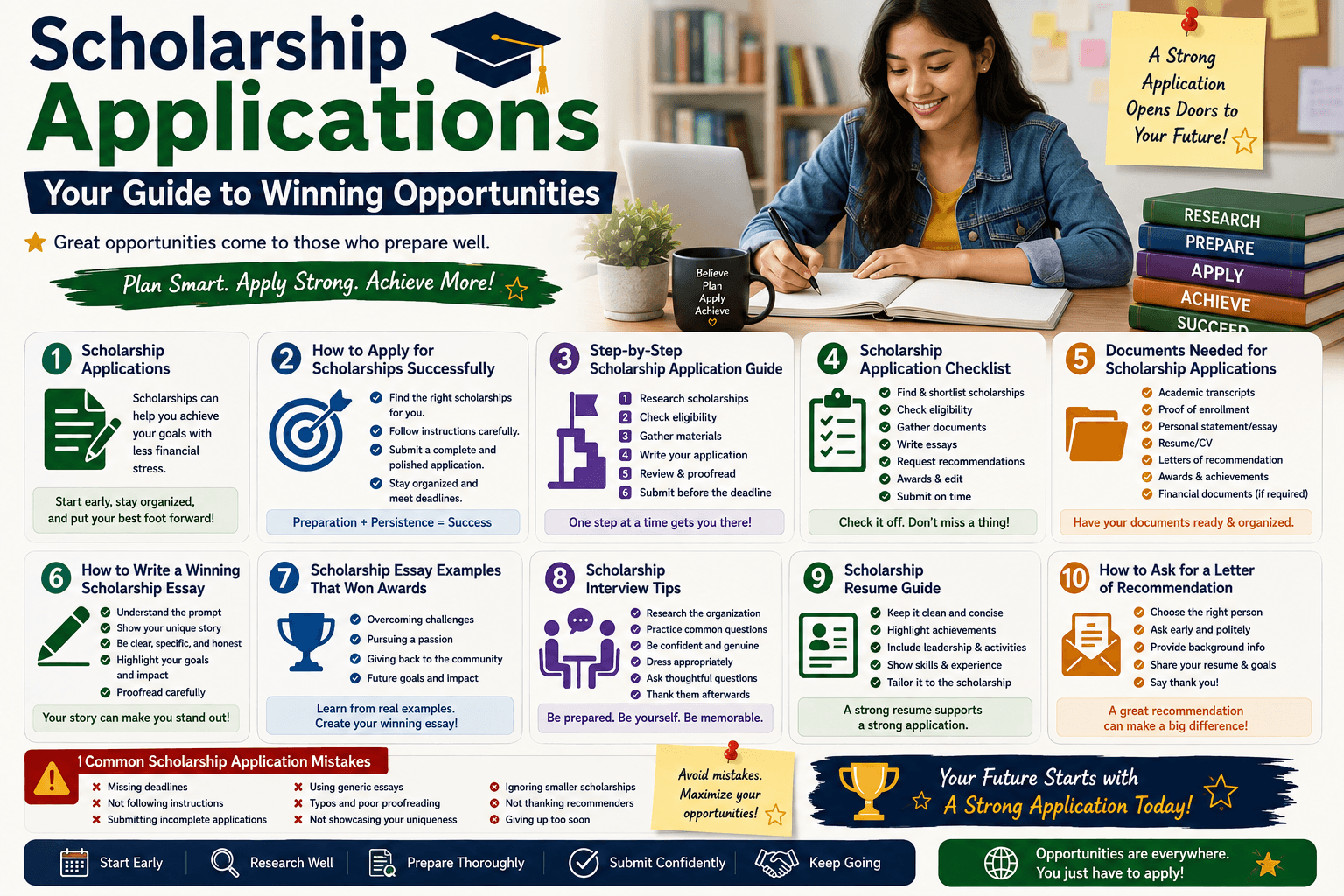
How to Apply for Scholarships Successfully
Winning scholarships is far less about luck than most people assume — it hinges on thorough prep work, attention to small details, and a deliberate strategy. The students who rack up the most scholarship wins aren’t always the top academic performers — more often, they’re simply the ones who apply widely and follow every guideline precisely.
A handful of consistent habits tend to define the most successful candidates:
Begin well ahead of deadlines — rushed applications are noticeably weaker, and last-minute essays rarely shine.
Study the guidelines closely — small oversights — wrong file type, missed word limit — are surprisingly common reasons for disqualification.
Customize every submission — reviewers can almost always tell when an essay wasn’t written specifically for their program.
Cast a wide net — the more programs you apply to, especially lesser-known local ones, the better your chances.
Step-by-Step Scholarship Application Guide
Use this basic roadmap for virtually any scholarship you apply to:
Search and select — gather a list of scholarships you’re eligible for, prioritizing ones that match your background, goals, or field of study.
Review criteria and due dates — list out all criteria and dates, then set up a simple calendar or spreadsheet to track them.
Assemble your materials — academic records, references, income documents, and any other requested files.
Write your application essay — plan for several rounds of revision rather than a single first attempt.
Secure your endorsements — reach out well in advance, giving your references weeks rather than days.
Review and proofread everything — check for typos, formatting issues, and whether you’ve actually answered the prompt.
Submit before the deadline — aim to submit at least a day or two early in case of technical issues.
Close the loop professionally — acknowledging the people who supported your application is a small gesture that matters.
Scholarship Application Checklist
Before you hit submit, run through this quick checklist:
Do you actually qualify based on every stated criterion?
Is your document set fully complete?
Did a second set of eyes review your writing?
Is your recommendation paperwork fully accounted for?
Does your application match the exact formatting requirements — word count, file type, font?
Have you confirmed your email and phone number are current?
Are you turning this in with room to spare, not at the last second?
Documents Needed for Scholarship Applications
Nearly every scholarship application draws from the same general pool of paperwork:
Official grade records — proof of your coursework, grades, and academic history.
Personal essay or statement — the section where you make your case — your background, ambitions, and motivations.
Reference letters — provided by someone who can speak credibly to your character and abilities.
CV or extracurricular summary — an overview of everything you’ve done — school, jobs, clubs, community service.
Proof of enrollment or acceptance — documentation proving your admission or attendance at an approved school.
Financial documents (if need-based) — tax returns, income statements, or aid forms like the FAFSA, when required.
How to Write a Winning Scholarship Essay
Among everything you submit, the essay tends to matter most — it’s where your personality and story come through, not just your GPA.
What Makes an Essay Actually Win
The most successful essays consistently follow a similar pattern:
A clear, specific story — specificity beats generality every time — one real story outperforms ten vague claims.
Genuine voice over polish — committee members notice immediately when an essay feels rehearsed or inauthentic.
A clear connection to your goals — make sure the reader understands why this experience matters for your future.
Thorough revision — even a compelling essay loses credibility with sloppy errors.
Scholarship Essay Examples That Won Awards
Though topics differ widely, most winning essays follow a recognizable pattern: they open with a vivid, specific moment, not a generic statement. The essay then ties that moment to a broader insight, value, or personal shift. They close by linking the story to future ambitions and explaining the scholarship’s role in achieving them.
Common winning topics include overcoming a specific challenge, a formative experience with a mentor, a moment that shifted a career goal, or a personal responsibility that shaped the applicant’s character. What matters isn’t the topic itself, but the specificity and honesty behind it.
Scholarship Interview Tips
Some scholarships include an interview stage, and for those, getting ready properly is crucial.
Be ready to discuss your own materials — expect follow-up questions on anything you wrote, so revisit your essay and resume beforehand.
Prepare for predictable questions — typical questions revolve around your goals, motivations, and reasons for applying.
Treat it like a real interview — treat every interview format with the same seriousness, video call or otherwise.
Show curiosity about the program — this shows genuine interest and helps you stand out from other candidates.
Scholarship Resume Guide
Scholarship resumes follow slightly different rules than typical job-application resumes — the focus shifts toward school achievements, community involvement, and leadership rather than paid work history.
Keep it well-organized, ideally one page, with clear sections for academics, extracurricular activities, volunteer work, awards, and skills. Favor active, specific language, and back up claims with real numbers when possible — “organized” rather than “helped with,” “raised $2,000” rather than “raised money”.
How to Ask for a Letter of Recommendation
Requesting a reference doesn’t have to be stressful if you handle it thoughtfully.
Give plenty of notice — the earlier you ask, the more thoughtful and detailed the letter tends to be.
Choose someone who knows you well — a person who genuinely knows your work, not simply the most senior name you can think of.
Provide context — hand them everything they need — your goals, the scholarship’s focus, and relevant accomplishments.
Send a gentle reminder if needed — a short nudge close to the due date is normal and expected.
Say thank you — regardless of the outcome, a thank-you note is simply good etiquette.
Common Scholarship Application Mistakes
Plenty of qualified applicants get passed over for entirely preventable reasons. Here are the mistakes that show up again and again:
Submitting late — late applications are almost always rejected outright, no exceptions.
Overlooking specific guidelines — failing to follow exact formatting or content rules often results in automatic rejection.
Generic, copy-pasted essays — a recycled essay rarely resonates the way a customized one does.
Asking recommenders at the last minute — the quality of your recommendation depends heavily on giving your recommender enough time and context.
Skipping the final review — small errors can undercut an otherwise excellent application.
Applying too narrowly — chasing only the most famous scholarships while skipping smaller programs with far less competition.
The Bottom Line for Beginners
More than anything, remember this — thorough preparation matters far more than a flawless application. Start early, follow instructions exactly, tell a genuine and specific story in your essay, and apply to as many legitimate opportunities as you reasonably can. It’s not always the strongest résumé that wins — frequently, it’s simply the applicant who showed up and applied.