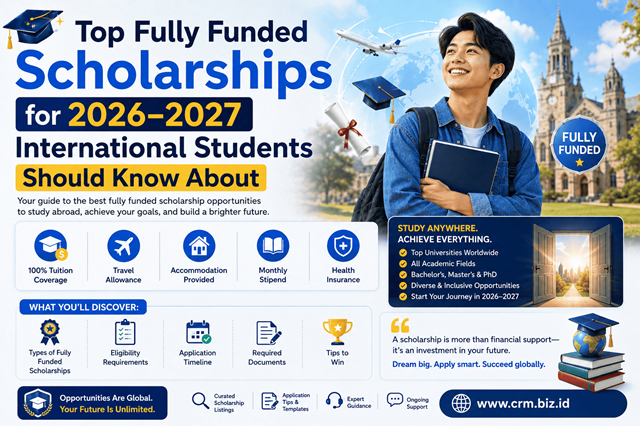
Every application season, hundreds of thousands of students globally search for a fully funded scholarship that gives them the opportunity to top universities in countries such as the United States, the United Kingdom, Germany, and other parts of Europe. The good news is that the 2026-2027 application cycle is rolling out, with a wide range of highly competitive programs accepting applications for students planning to begin their studies in the 2027 intake.
Below, let’s break down some of the most popular scholarships currently trending, touching on eligibility, the benefits, and roughly when the deadlines fall. One important reminder: scholarship dates and requirements shift slightly every cycle, so make sure you verify the official program page of the scholarship you choose before submitting your documents.
1. Fulbright Scholarship – United States
The Fulbright Program continues to be one of the most well-known scholarship names in the world, sponsored by the American government. The program funds postgraduate education in the U.S., usually covering full tuition, monthly living costs, travel, and medical coverage.
What makes Fulbright unique is that the application timeline is different depending on where you apply from, since every nation involved has a designated embassy office handling the process. For many countries, deadlines fall between May and October, which is why it’s important to confirm the Fulbright Commission website for your country for accurate dates.
2. The Chevening Scholarship (UK)
The Chevening Scholarship is the British government’s signature fully funded program for emerging professionals around the world. Recipients receive funding for a full master’s program at any UK university, including tuition, monthly stipend, travel costs, and additional allowances.
The upcoming intake typically opens in early August and closes in early October or November, so applicants are encouraged to begin preparing their application materials well ahead of time, since Chevening’s essay questions are known to be one of the most competitive parts of the process.
3. DAAD Study and Research Scholarships (Germany)
The German Academic Exchange Service, better known as DAAD runs dozens of scholarship categories for international students, ranging from everything from summer courses to doctoral studies.
A particularly well-known program for international graduate students is the Study Scholarships for Foreign Graduates program, which generally covers a monthly stipend, health insurance, and a travel allowance. Its closing date typically land around October for enrollment about a year later. Given Germany’s low or no tuition fees, a large number of students apply alongside DAAD funding with direct university admission as a safety net.
4. Erasmus Mundus Joint Master Degrees (European Union)
Erasmus Mundus is a little different from other scholarships mentioned here, because it isn’t a single centralized scholarship. Rather, the program supports joint master’s programs run jointly by multiple universities in different EU countries, which means students usually relocate at least once during the program.
Funding typically includes tuition fees, a competitive monthly stipend, and travel and insurance coverage. Since every program has its own timeline, deadlines are scattered between autumn and early winter, so prospective applicants should shortlist their preferred programs early and track each one individually.
5. Australia Awards Scholarship (Australia)
For students interested in the Asia-Pacific region, this Australian government program are one of the most comprehensive options available, covering tuition fees, flights, settling-in costs, and a monthly allowance.
This scholarship is designed for applicants from eligible developing countries, with the application period usually running from around February through April or later, which makes checking your country’s specific guidelines a must.
6. Swiss Excellence Scholarships – Switzerland
Switzerland’s federal government, through its Federal Commission for Scholarships, offers research scholarships primarily aimed at doctoral-level and postdoctoral researchers, along with a smaller number of opportunities for artists and select master’s applicants.
The monthly stipend is considered among the more generous when compared to similar programs, and applications are typically submitted through Swiss embassies or directly to host universities between October and December.
7. Japan’s MEXT Scholarship
Even though Japan sits outside Europe and North America, it is classified as a highly developed nation, and its government-funded MEXT Scholarship is among the most popular scholarships internationally.
The scholarship funds tuition fees, a living allowance, and flights to and from Japan, and has two main application routes: via your local Japanese embassy or through direct university recommendation. Embassy-track deadlines commonly fall in late May or June, with written exams and interviews to follow.
8. Gates Cambridge – UK
Sponsored through a grant from the Bill and Melinda Gates Foundation, this program is reserved for high-achieving applicants from outside the United Kingdom to pursue a full-time postgraduate degree specifically at Cambridge University.
Few scholarships are as selective as this one, with an acceptance rate often compared to the world’s top fellowships. Recipients get complete tuition coverage along with a generous living and travel budget, and the application closes sometime in the final quarter of the year, varying by program.
How to Improve Your Chances
Getting a fully funded scholarship is highly competitive, but there are a few things that consistently help applicants stand out:
– Don’t wait until the last minute — your strongest application materials usually go through several drafts.
– Research each program’s specific requirements rather than trusting outdated blog posts.
– Customize your motivation letter so it reflects what that specific program is looking for.
– Ask for recommendation letters early, since a rushed letter rarely stands out.
– Set reminders for each application window so nothing slips through the cracks.
In Conclusion
The current application period presents no shortage of chances for anyone aiming to study in developed countries throughout the West and beyond. Whether you’re aiming for Fulbright, Chevening, DAAD, Erasmus Mundus, or another program, the key is patience combined with a genuinely strong application.
Make it a habit to double-check every detail through the program’s official channel, since requirements are occasionally updated. With the right preparation, the goal of tuition-free study abroad is closer than you think.