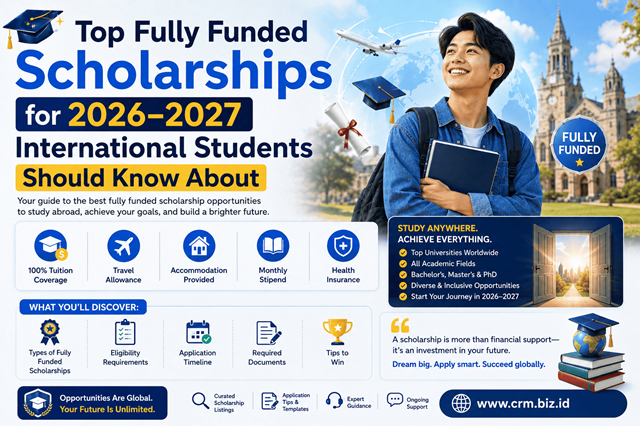
Every application season, thousands of students globally look for a tuition-free scholarship that will let them study to world-class universities in developed countries. Fortunately that the 2026-2027 funding cycle is now open, with a wide range of well-known programs opening their portals for students aiming to start a degree in 2027.
In this article, we will walk through some of the most sought-after scholarships currently trending, including who can apply, the funding details, and roughly when applications open and close. Keep in mind: scholarship dates and requirements shift slightly every cycle, so it’s essential to double-check the official program page of each scholarship before applying.
1. Fulbright Foreign Student Program (United States)
The Fulbright Program continues to be one of the most well-known scholarship brands globally, funded by the U.S. Department of State. It covers graduate-level study in the U.S., usually covering full tuition, monthly living costs, travel, and medical coverage.
One thing that sets Fulbright apart is that the application timeline is different depending on where you apply from, since each participating country has a designated embassy office handling the process. Generally speaking, deadlines fall between May and October, meaning you should verify the official Fulbright portal for the most current information.
2. Chevening Scholarship (United Kingdom)
The Chevening Scholarship is the UK government’s most prestigious fully funded program for students with leadership potential across more than 160 countries. The award covers a one-year master’s degree at virtually any university in the United Kingdom, including tuition, monthly stipend, travel costs, and additional allowances.
This year’s Chevening application round usually runs from August through the fall, so applicants should start drafting their essays early, since the four required essays are known to be a major factor in selection.
3. DAAD Study and Research Scholarships (Germany)
Germany’s DAAD runs over a hundred funding schemes for foreign graduates, covering everything from summer courses to doctoral studies.
A particularly well-known program for those pursuing a master’s degree is the DAAD Study Scholarship, which pays a monthly allowance plus insurance and flight support. Its closing date usually fall in mid-October for the following academic year’s intake. Given Germany’s low or no tuition fees, plenty of candidates combine DAAD funding with independent applications as a secondary option.
4. Erasmus Mundus Joint Master Degrees (European Union)
Erasmus Mundus works differently compared to other scholarships on this list, because there’s no single application portal. Instead, it finances study tracks taught across two or more universities in Europe, meaning students often study in two or three different countries during their degree.
The scholarship usually covers tuition fees, a competitive monthly stipend, and travel and insurance coverage. As each joint program manages its own schedule, deadlines are scattered between autumn and early winter, which is why early research into specific programs is essential.
5. Australia Awards – Australia
For students interested in the Asia-Pacific region, Australia Awards is among the most generous funding packages on offer, providing for full tuition, return airfare, a establishment allowance, and a living stipend.
This program mainly targets applicants from eligible developing countries, with the application period usually running from around February through April or later, so checking the country-specific page is essential.
6. Swiss Excellence Scholarships – Switzerland
The Swiss government, via its official scholarship commission, offers research-based scholarships mostly targeted at advanced researchers, with a limited number of spots for art students and certain master’s programs.
The living allowance is relatively high compared to many other government scholarships, and applications are typically submitted through Swiss embassies or directly to host universities between October and December.
7. MEXT – Japan
Although Japan is in Asia rather than the West, Japan is considered a highly developed nation, and the MEXT Scholarship, funded by Japan’s Ministry of Education is among the most popular scholarships internationally.
The scholarship funds full tuition, a monthly stipend, and round-trip airfare, and is available through embassy screening or a university-recommended track. Embassy-track deadlines typically land in the late spring, followed by written and interview rounds.
8. Gates Cambridge Scholarship (United Kingdom)
Sponsored through a grant from the Bill and Melinda Gates Foundation, the Gates Cambridge Scholarship funds outstanding students from outside the UK to complete graduate study specifically at Cambridge University.
It is considered one of the most competitive scholarships globally, due to the sheer number of applicants each year. Recipients get complete tuition coverage along with a generous living and travel budget, and the application closes sometime in the final quarter of the year, varying by program.
Tips for a Stronger Application
Getting a fully funded scholarship takes real effort, but a few strategies can meaningfully boost your chances:
– Begin months in advance — a well-written personal statement isn’t written overnight.
– Research each program’s specific requirements and always cross-check with the official scholarship website.
– Adjust your essay so it reflects what that specific program is looking for.
– Give your recommenders plenty of notice, since good references take time to write properly.
– Set reminders for each application window since missing a deadline is one of the most common and avoidable mistakes.
Wrapping Up
This year’s funding season presents a wide range of options for students who dream of studying in developed countries such as the United States, the United Kingdom, Germany, and other parts of Europe, as well as Australia and Japan. Regardless of the specific program you choose, the key is starting early and staying organized.
Never rely solely on secondhand information directly on each scholarship’s official website, since dates and policies can shift from one cycle to the next. Given enough time and effort, the possibility of a funded degree overseas is more achievable than it might seem.