Scholarship Applications: What Every Student Needs to Know
Tackling a scholarship application often feels like a maze of forms, essays, and deadlines. With so many moving parts — essays, paperwork, due dates — confusion is completely normal. The reassuring reality is this: breaking the process into clear steps turns something intimidating into something completely doable.
Below, we’ll cover every essential piece — beginning with preparation and ending with post-application etiquette — so you can apply with confidence and actually improve your odds of winning.
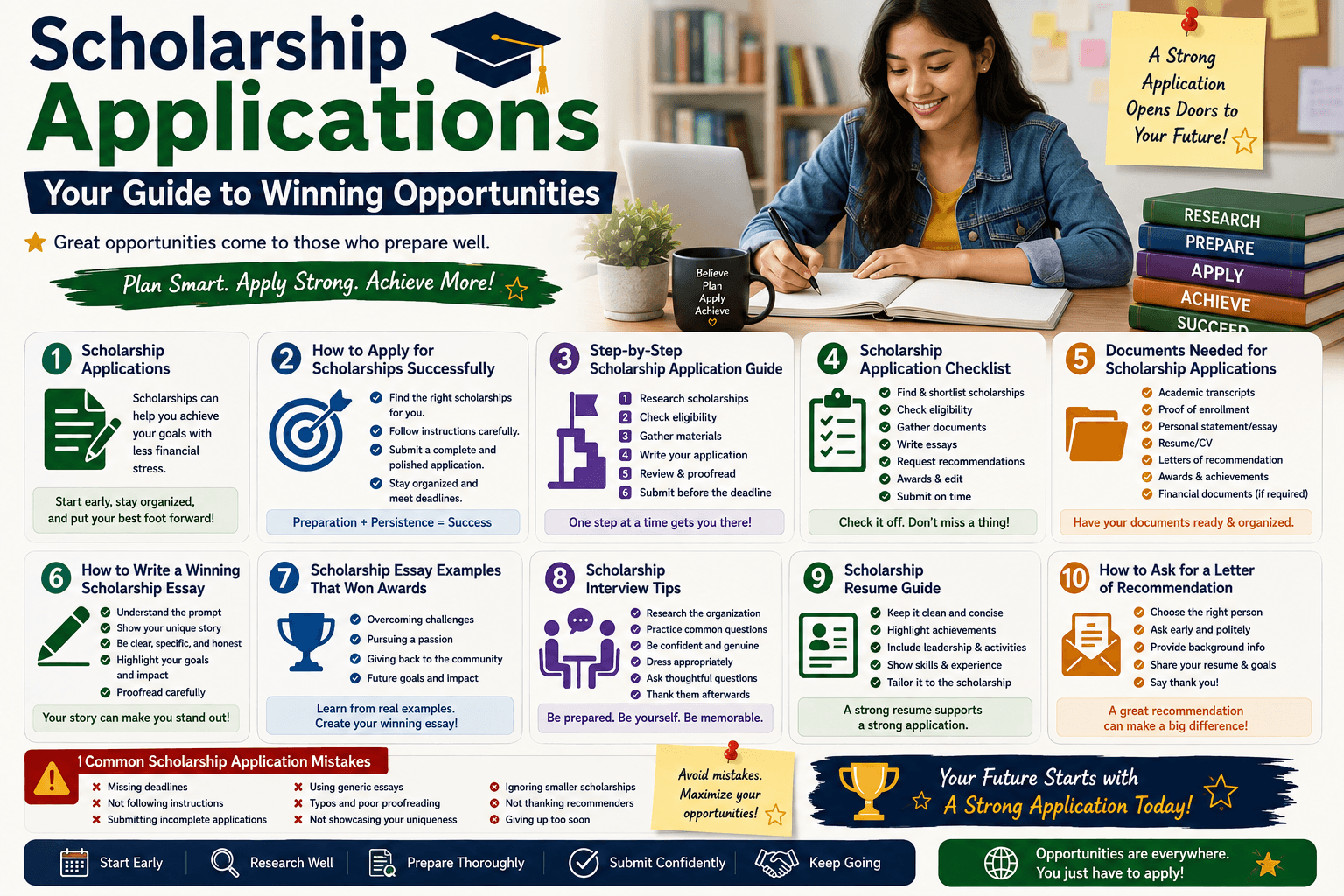
How to Apply for Scholarships Successfully
Winning scholarships is far less about luck than most people assume — it’s really about careful preparation, precision, and a smart, targeted approach. The students who win the most scholarships aren’t necessarily the smartest — frequently, they’re just the applicants who submit the most applications and read the fine print.
A handful of consistent habits tend to define the most successful candidates:
Begin well ahead of deadlines — rushed applications are noticeably weaker, and last-minute essays rarely shine.
Study the guidelines closely — overlooking something minor, like formatting rules, can knock out an application that would’ve otherwise been competitive.
Customize every submission — reviewers can almost always tell when an essay wasn’t written specifically for their program.
Apply broadly — applying to more scholarships, including smaller local ones, significantly boosts your overall odds.
Step-by-Step Scholarship Application Guide
Use this basic roadmap for virtually any scholarship you apply to:
Search and select — compile scholarships you qualify for, focusing on those aligned with your interests, major, or personal story.
Review criteria and due dates — write down every requirement and deadline, then organize them somewhere easy to check.
Collect required paperwork — whatever’s needed — grades, letters, financial paperwork — pull it together early.
Compose your personal statement — give yourself enough time to write multiple drafts, not just one rushed version.
Secure your endorsements — reach out well in advance, giving your references weeks rather than days.
Polish the entire application — scan for errors and confirm every part of the prompt has genuinely been addressed.
Send it in early, not at the last second — aim to submit at least a day or two early in case of technical issues.
Follow up if appropriate — a short thank-you note to recommenders or interviewers leaves a lasting positive impression.
Scholarship Application Checklist
Use this rapid checklist right before you finalize anything:
Have you met every eligibility requirement?
Are every one of the requested files actually included?
Has anyone besides you checked your essay for errors?
Have your references actually turned in their letters?
Did you double-check the technical specs, like word limits and accepted file types?
Is your contact information accurate and up to date?
Have you submitted before the actual deadline, with buffer time to spare?
Documents Needed for Scholarship Applications
Nearly every scholarship application draws from the same general pool of paperwork:
Official grade records — official records showing what you’ve studied and how you’ve performed.
Personal statement — your chance to explain your goals, story, or why you deserve the award.
Reference letters — written by teachers, mentors, employers, or coaches who know your work well.
List of achievements and activities — a snapshot of your involvement across academics, activities, and community work.
Enrollment verification — confirming you’re enrolled in, or accepted to, an eligible school or program.
Financial documents (if need-based) — records such as tax filings or financial aid applications, if the scholarship is need-based.
How to Write a Winning Scholarship Essay
Among everything you submit, the essay tends to matter most — it’s the one section where numbers take a back seat to who you actually are.
What Makes an Essay Actually Win
The most successful essays consistently follow a similar pattern:
One vivid, specific example — rather than generic claims, show a particular experience that demonstrates the point.
Genuine voice over polish — reviewers read hundreds of essays and can spot a generic, overly polished response instantly.
A direct link to your future plans — make sure the reader understands why this experience matters for your future.
Thorough revision — small mistakes can undercut an otherwise excellent piece of writing.
Scholarship Essay Examples That Won Awards
Award-winning essays vary in topic but often share a consistent framework: they begin with a concrete scene or detail rather than a broad opening line. From there, they connect that moment to a lesson, value, or turning point. They close by linking the story to future ambitions and explaining the scholarship’s role in achieving them.
Frequent themes among award-winning essays include hardship overcome, a pivotal mentorship, a career-defining moment, or a responsibility that built character. It’s not about picking a dramatic topic — it’s about telling any topic with real honesty and detail.
Scholarship Interview Tips
When an interview is part of the process, thorough preparation can make or break your chances.
Review everything you submitted — expect follow-up questions on anything you wrote, so revisit your essay and resume beforehand.
Practice common questions — expect standard prompts such as your career plans or why you’re a strong candidate.
Treat it like a real interview — whether online or face-to-face, professionalism matters just as much.
Prepare a few genuine questions for the panel — thoughtful questions demonstrate that you’ve actually researched the organization.
Scholarship Resume Guide
A scholarship resume looks a bit different from a job resume — it centers on academic and community contributions instead of formal employment.
Keep it well-organized, ideally one page, with clear sections for school achievements, clubs, community service, honors, and relevant abilities. Lead with active language and include numbers whenever you can — precision in both language and figures makes a resume far more convincing.
How to Ask for a Letter of Recommendation
Asking for a recommendation letter can feel awkward, but a little strategy makes it much easier.
Reach out well in advance — the earlier you ask, the more thoughtful and detailed the letter tends to be.
Choose someone who knows you well — someone who can speak to specific strengths or experiences, not just someone with a impressive title.
Share helpful background information — hand them everything they need — your goals, the scholarship’s focus, and relevant accomplishments.
Follow up politely — checking in respectfully, rather than repeatedly, keeps the relationship positive.
Say thank you — whether or not you win, showing appreciation matters and is remembered.
Common Scholarship Application Mistakes
Some of the most competitive students still lose scholarships over simple, fixable mistakes. Watch out for these common pitfalls:
Missing deadlines — most programs won’t even review a submission that arrives after the cutoff.
Skipping stated requirements — failing to follow exact formatting or content rules often results in automatic rejection.
Reusing the same essay for every application — a recycled essay rarely resonates the way a customized one does.
Choosing the wrong recommender — a hastily written letter from someone who barely knows you rarely helps your case.
Submitting work full of typos — small errors can undercut an otherwise excellent application.
Only going for the “big” scholarships — focusing only on large, highly competitive national awards while ignoring smaller local ones with better odds.
The Bottom Line for Beginners
More than anything, remember this — thorough preparation matters far more than a flawless application. Start early, follow instructions exactly, tell a genuine and specific story in your essay, and apply to as many legitimate opportunities as you reasonably can. It’s not always the strongest résumé that wins — frequently, it’s simply the applicant who showed up and applied.