Scholarship Applications: What Every Student Needs to Know
Sitting down to complete a scholarship application can seem far more complicated than it actually needs to be. Between essays, documents, deadlines, and requirements, it’s easy to feel lost. But here’s the truth: breaking the process into clear steps turns something intimidating into something completely doable.
This guide walks through everything you need — from the very first step to the final follow-up — so you can apply with confidence and actually improve your odds of winning.
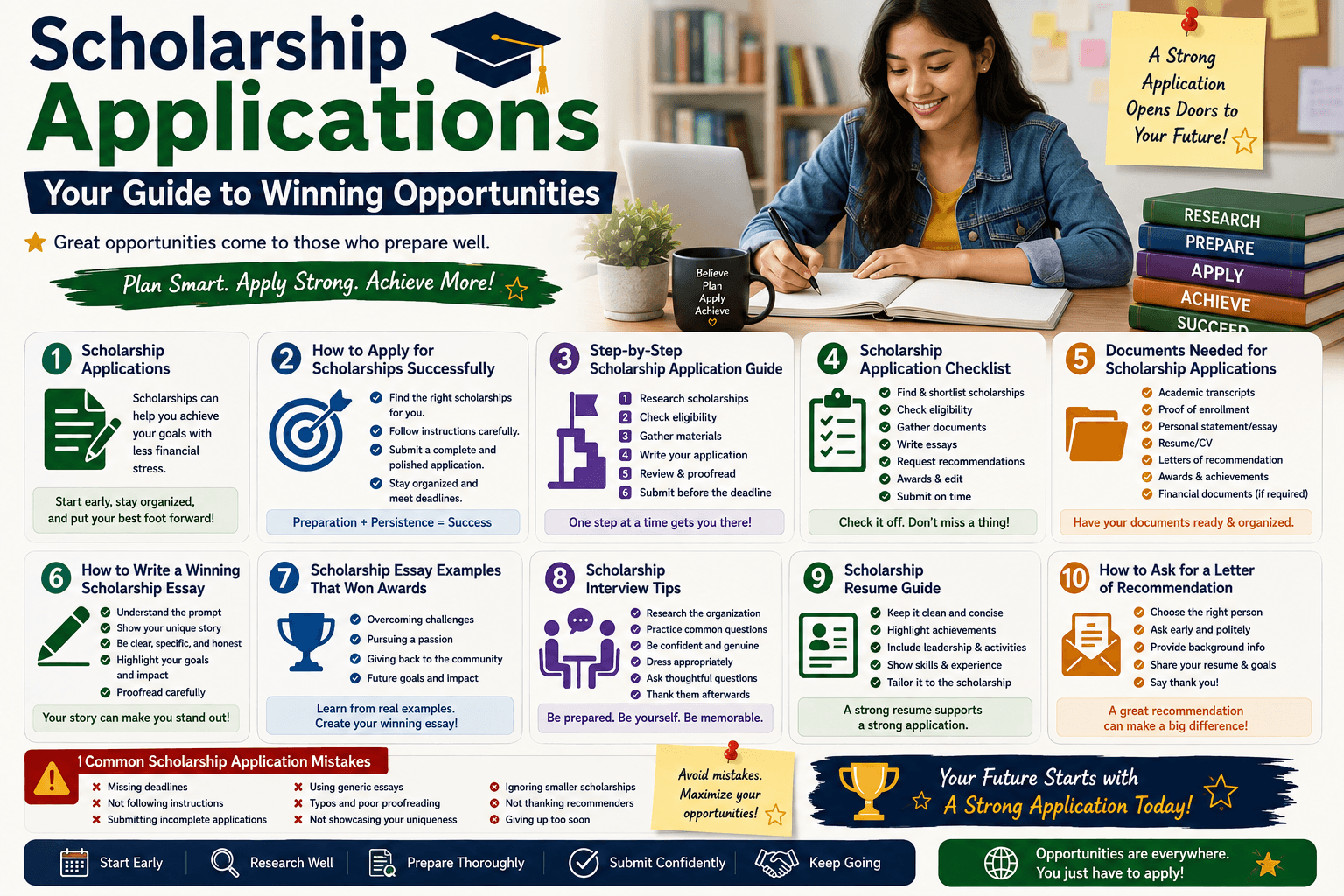
How to Apply for Scholarships Successfully
Success with scholarship applications rarely comes down to luck — it comes down to preparation, attention to detail, and applying strategically. The students who win the most scholarships aren’t necessarily the smartest — more often, they’re simply the ones who apply widely and follow every guideline precisely.
A few core habits separate successful applicants from everyone else:
Start early — rushed applications are noticeably weaker, and last-minute essays rarely shine.
Study the guidelines closely — missing a small detail, like a word count or file format, can disqualify an otherwise strong application.
Personalize each application specifically — recycled, one-size-fits-all responses tend to stand out for the wrong reasons.
Cast a wide net — applying to more scholarships, including smaller local ones, significantly boosts your overall odds.
Step-by-Step Scholarship Application Guide
Here’s a simple, repeatable process to follow for nearly any scholarship:
Find and narrow down — build a list of eligible opportunities, weighting it toward programs that genuinely fit who you are.
Check requirements and deadlines — write down every requirement and deadline, then organize them somewhere easy to check.
Collect required paperwork — whatever’s needed — grades, letters, financial paperwork — pull it together early.
Compose your personal statement — give yourself enough time to write multiple drafts, not just one rushed version.
Secure your endorsements — reach out well in advance, giving your references weeks rather than days.
Polish the entire application — check for typos, formatting issues, and whether you’ve actually answered the prompt.
Submit before the deadline — give yourself buffer time before the cutoff in case something goes wrong.
Send a thank-you note when relevant — a short thank-you note to recommenders or interviewers leaves a lasting positive impression.
Scholarship Application Checklist
Use this rapid checklist right before you finalize anything:
Does your profile match all listed eligibility rules?
Is your document set fully complete?
Did a second set of eyes review your writing?
Is your recommendation paperwork fully accounted for?
Does your application match the exact formatting requirements — word count, file type, font?
Is there any outdated contact info that needs fixing?
Did you leave yourself cushion time before the true cutoff?
Documents Needed for Scholarship Applications
While requirements vary, a familiar set of documents tends to reappear across applications:
Official grade records — documentation verifying your classes and performance record.
Personal essay or statement — your opportunity to show, in your own words, why you’re a strong candidate.
Reference letters — provided by someone who can speak credibly to your character and abilities.
CV or extracurricular summary — a snapshot of your involvement across academics, activities, and community work.
Enrollment verification — showing your current or upcoming enrollment status at a qualifying institution.
Income verification paperwork — records such as tax filings or financial aid applications, if the scholarship is need-based.
How to Write a Winning Scholarship Essay
Nothing in the application usually carries more weight than the essay — it’s the one section where numbers take a back seat to who you actually are.
What Makes an Essay Actually Win
Strong scholarship essays tend to share a few key traits:
A clear, specific story — instead of vague statements like “I’ve always worked hard,” describe a specific moment that proves it.
Honesty over impressiveness — reviewers read hundreds of essays and can spot a generic, overly polished response instantly.
An obvious tie to why the award matters — make sure the reader understands why this experience matters for your future.
Thorough revision — even a compelling essay loses credibility with sloppy errors.
Scholarship Essay Examples That Won Awards
Though topics differ widely, most winning essays follow a recognizable pattern: they open with a vivid, specific moment, not a generic statement. The essay then ties that moment to a broader insight, value, or personal shift. They close by linking the story to future ambitions and explaining the scholarship’s role in achieving them.
Frequent themes among award-winning essays include hardship overcome, a pivotal mentorship, a career-defining moment, or a responsibility that built character. The subject matters less than how genuinely and specifically it’s told.
Scholarship Interview Tips
When an interview is part of the process, thorough preparation can make or break your chances.
Review everything you submitted — expect follow-up questions on anything you wrote, so revisit your essay and resume beforehand.
Practice common questions — typical questions revolve around your goals, motivations, and reasons for applying.
Dress and present professionally — even a virtual interview deserves the same level of preparation as an in-person one.
Ask thoughtful questions of your own — thoughtful questions demonstrate that you’ve actually researched the organization.
Scholarship Resume Guide
Unlike a professional resume, a scholarship resume has its own format — it should highlight academics, extracurriculars, volunteer work, and leadership rather than professional experience.
Structure it cleanly, aim for a single page, and use clearly labeled sections for school achievements, clubs, community service, honors, and relevant abilities. Lead with active language and include numbers whenever you can — specific verbs and specific numbers always beat vague descriptions.
How to Ask for a Letter of Recommendation
Asking for a recommendation letter can feel awkward, but a little strategy makes it much easier.
Reach out well in advance — a month’s notice, if possible, respects their schedule and results in a stronger letter.
Choose someone who knows you well — someone who can speak to specific strengths or experiences, not just someone with a impressive title.
Give them useful material to work with — share your essay draft, key achievements, and details about the award itself.
Check in respectfully as the deadline nears — checking in respectfully, rather than repeatedly, keeps the relationship positive.
Close the loop with gratitude — regardless of the outcome, a thank-you note is simply good etiquette.
Common Scholarship Application Mistakes
Plenty of qualified applicants get passed over for entirely preventable reasons. These recurring errors are worth avoiding at all costs:
Submitting late — deadlines in scholarship applications are rarely, if ever, flexible.
Ignoring instructions — failing to follow exact formatting or content rules often results in automatic rejection.
Reusing the same essay for every application — committees notice immediately when an applicant didn’t bother personalizing their response.
Weak or rushed recommendation letters — a hastily written letter from someone who barely knows you rarely helps your case.
Poor proofreading — sloppy writing signals carelessness, even when the substance is strong.
Applying too narrowly — focusing only on large, highly competitive national awards while ignoring smaller local ones with better odds.
The Bottom Line for Beginners
The clearest takeaway here is simple: preparation beats perfection every time. Give yourself time, respect every guideline, be authentic in your writing, and cast as wide a net as realistically possible. The students who win aren’t always the most qualified on paper — often, they’re simply the ones who applied.