
Scholarship Applications: What Every Student Needs to Know
Filling out a scholarship application can feel far more complicated than it actually needs to be. With so many moving parts — essays, paperwork, due dates — confusion is completely normal. The reassuring reality is this: the scholarship application process gets far easier once you know what to expect.
What follows breaks down each part of the process — start to finish, from your first draft to your last thank-you note — equipping you to submit stronger applications and increase your real odds of success.
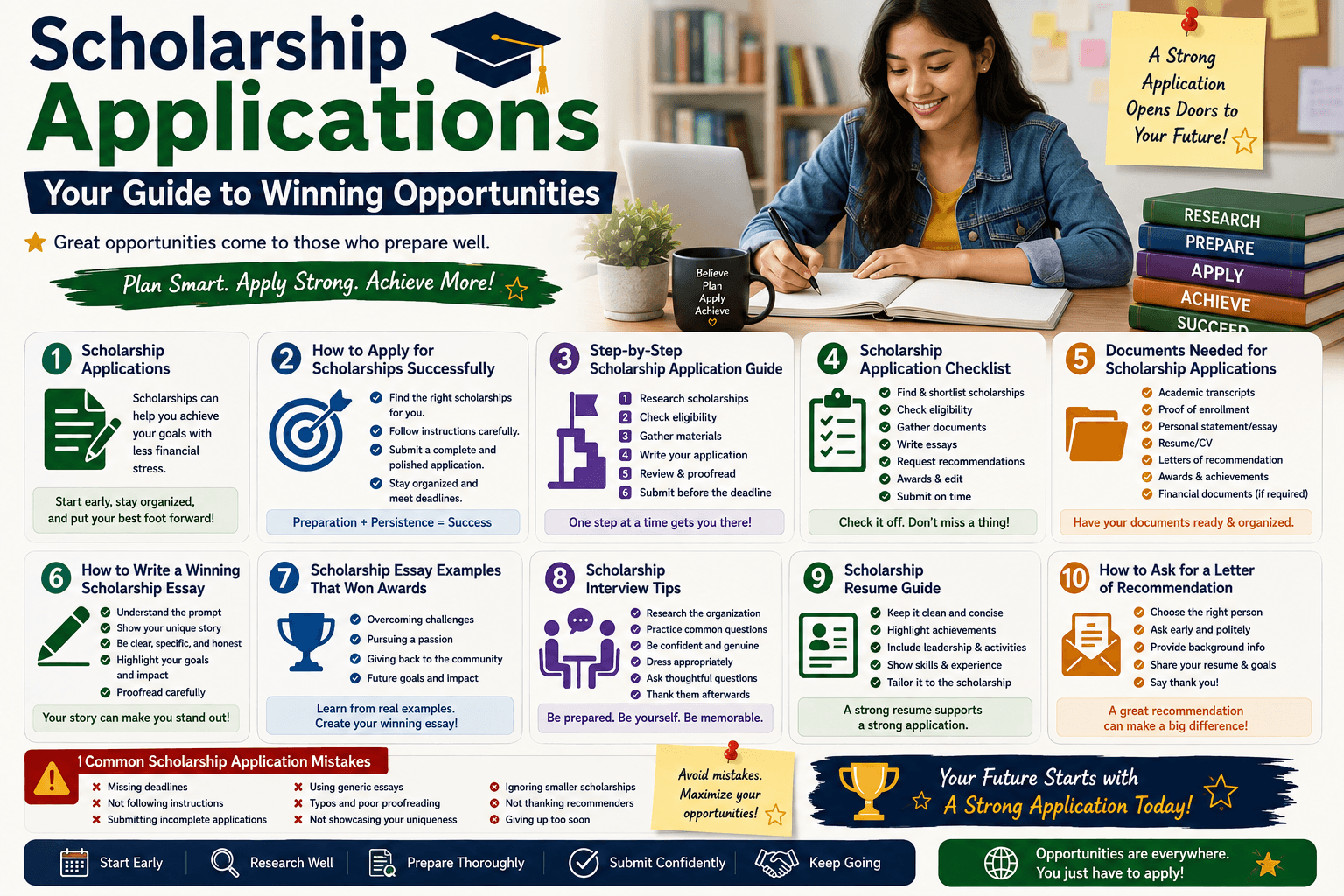
How to Apply for Scholarships Successfully
Winning scholarships is far less about luck than most people assume — it’s really about careful preparation, precision, and a smart, targeted approach. The students who win the most scholarships aren’t necessarily the smartest — they’re usually the ones who apply to the most opportunities and follow instructions carefully.
Several key practices consistently set winning applicants apart:
Get going long before due dates — scholarship committees can usually tell when an essay was written the night before.
Pay close attention to every instruction — overlooking something minor, like formatting rules, can knock out an application that would’ve otherwise been competitive.
Customize every submission — reviewers can almost always tell when an essay wasn’t written specifically for their program.
Apply broadly — the more programs you apply to, especially lesser-known local ones, the better your chances.
Step-by-Step Scholarship Application Guide
Use this basic roadmap for virtually any scholarship you apply to:
Research and shortlist — build a list of eligible opportunities, weighting it toward programs that genuinely fit who you are.
Review criteria and due dates — list out all criteria and dates, then set up a simple calendar or spreadsheet to track them.
Collect required paperwork — academic records, references, income documents, and any other requested files.
Draft your essay or personal statement — give yourself enough time to write multiple drafts, not just one rushed version.
Secure your endorsements — give recommenders plenty of notice, ideally several weeks before the deadline.
Edit and double-check your materials — check for typos, formatting issues, and whether you’ve actually answered the prompt.
Send it in early, not at the last second — give yourself buffer time before the cutoff in case something goes wrong.
Follow up if appropriate — a brief message of appreciation to anyone who helped you goes a long way.
Scholarship Application Checklist
Before you hit submit, run through this quick checklist:
Have you met every eligibility requirement?
Is your document set fully complete?
Has your essay been proofread by someone other than yourself?
Have your references actually turned in their letters?
Did you double-check the technical specs, like word limits and accepted file types?
Is your contact information accurate and up to date?
Have you submitted before the actual deadline, with buffer time to spare?
Documents Needed for Scholarship Applications
While requirements vary, a familiar set of documents tends to reappear across applications:
Academic transcripts — proof of your coursework, grades, and academic history.
Personal statement — your opportunity to show, in your own words, why you’re a strong candidate.
Reference letters — provided by someone who can speak credibly to your character and abilities.
CV or extracurricular summary — a snapshot of your involvement across academics, activities, and community work.
Enrollment verification — showing your current or upcoming enrollment status at a qualifying institution.
Financial documents (if need-based) — paperwork proving household income, typically required only for need-based awards.
How to Write a Winning Scholarship Essay
Nothing in the application usually carries more weight than the essay — it’s your chance to stand out beyond grades and test scores.
What Makes an Essay Actually Win
The most successful essays consistently follow a similar pattern:
A focused, concrete narrative — rather than generic claims, show a particular experience that demonstrates the point.
Genuine voice over polish — reviewers read hundreds of essays and can spot a generic, overly polished response instantly.
An obvious tie to why the award matters — connect your story directly to your academic or career ambitions.
Careful editing — small mistakes can undercut an otherwise excellent piece of writing.
Scholarship Essay Examples That Won Awards
Award-winning essays vary in topic but often share a consistent framework: they begin with a concrete scene or detail rather than a broad opening line. From there, they connect that moment to a lesson, value, or turning point. Finally, they tie everything back to the applicant’s future goals and why the scholarship matters.
Frequent themes among award-winning essays include hardship overcome, a pivotal mentorship, a career-defining moment, or a responsibility that built character. The subject matters less than how genuinely and specifically it’s told.
Scholarship Interview Tips
When an interview is part of the process, thorough preparation can make or break your chances.
Review everything you submitted — interviewers frequently probe deeper into your application, so know your own answers inside and out.
Rehearse likely prompts — questions like “why do you deserve this scholarship” or “what are your future goals” come up often.
Dress and present professionally — whether online or face-to-face, professionalism matters just as much.
Show curiosity about the program — this shows genuine interest and helps you stand out from other candidates.
Scholarship Resume Guide
Unlike a professional resume, a scholarship resume has its own format — it should highlight academics, extracurriculars, volunteer work, and leadership rather than professional experience.
Structure it cleanly, aim for a single page, and use clearly labeled sections for coursework, activities, service work, recognitions, and useful skills. Favor active, specific language, and back up claims with real numbers when possible — specific verbs and specific numbers always beat vague descriptions.
How to Ask for a Letter of Recommendation
This step often feels uncomfortable, but the right approach removes most of the anxiety.
Ask early — the earlier you ask, the more thoughtful and detailed the letter tends to be.
Pick a recommender who can speak specifically about you — a person who genuinely knows your work, not simply the most senior name you can think of.
Provide context — hand them everything they need — your goals, the scholarship’s focus, and relevant accomplishments.
Check in respectfully as the deadline nears — a brief, courteous reminder a week before the deadline is completely appropriate.
Express genuine appreciation — whether or not you win, showing appreciation matters and is remembered.
Common Scholarship Application Mistakes
Some of the most competitive students still lose scholarships over simple, fixable mistakes. Here are the mistakes that show up again and again:
Missing deadlines — late applications are almost always rejected outright, no exceptions.
Skipping stated requirements — small procedural errors are one of the most common, and avoidable, reasons applications get tossed out.
Submitting a one-size-fits-all response — a recycled essay rarely resonates the way a customized one does.
Choosing the wrong recommender — last-minute requests often result in generic, unenthusiastic letters.
Poor proofreading — sloppy writing signals carelessness, even when the substance is strong.
Only going for the “big” scholarships — focusing only on large, highly competitive national awards while ignoring smaller local ones with better odds.
The Bottom Line for Beginners
More than anything, remember this — thorough preparation matters far more than a flawless application. Start early, follow instructions exactly, tell a genuine and specific story in your essay, and apply to as many legitimate opportunities as you reasonably can. The students who win aren’t always the most qualified on paper — often, they’re simply the ones who applied.