Scholarship Applications: What Every Student Needs to Know
Tackling a scholarship application often feels like a maze of forms, essays, and deadlines. With so many moving parts — essays, paperwork, due dates — confusion is completely normal. But here’s the truth: the scholarship application process gets far easier once you know what to expect.
This guide walks through everything you need — start to finish, from your first draft to your last thank-you note — giving you the confidence and strategy needed to genuinely boost your chances.
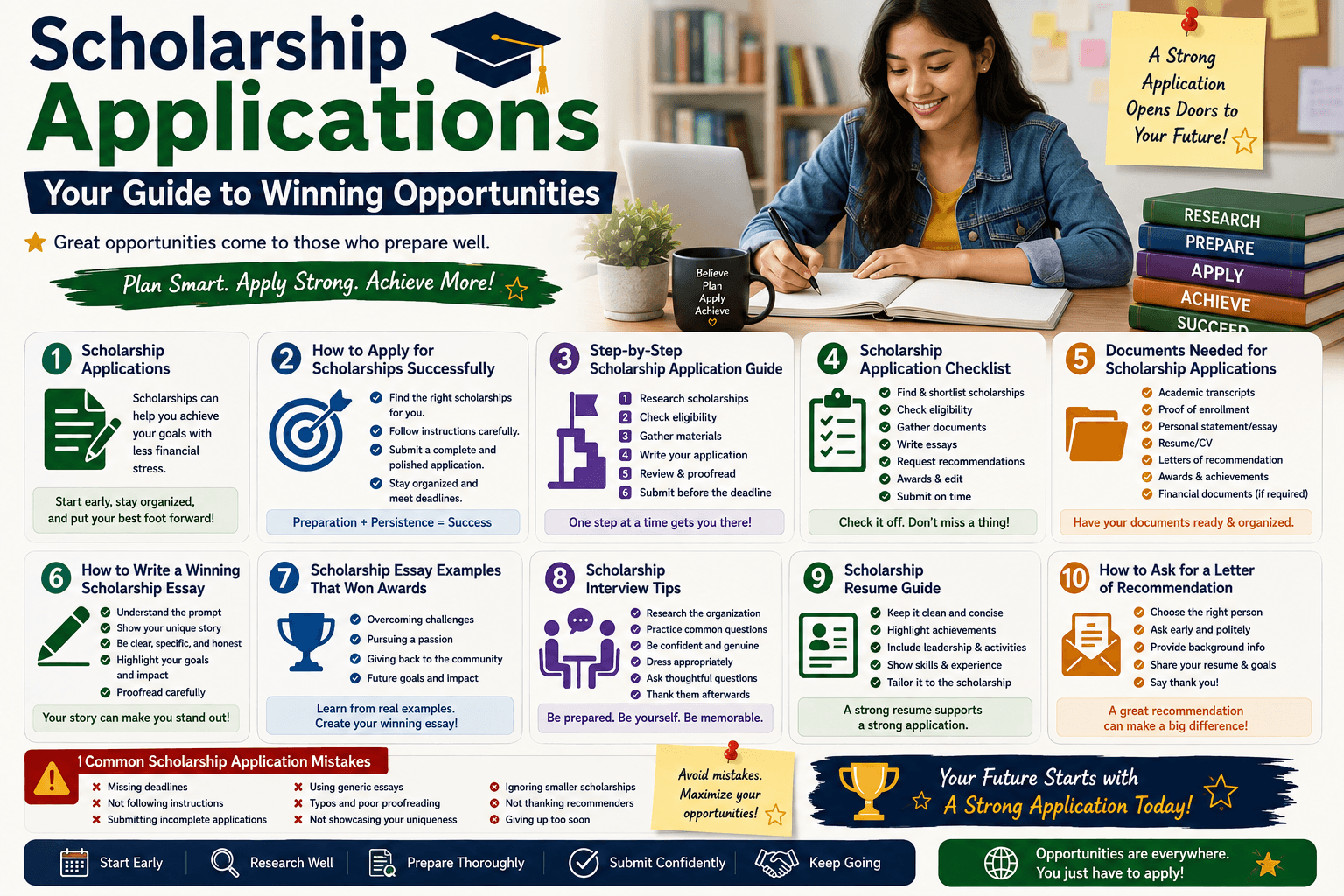
How to Apply for Scholarships Successfully
Success with scholarship applications rarely comes down to luck — it comes down to preparation, attention to detail, and applying strategically. It’s not always the highest-achieving students who collect the most awards — they’re usually the ones who apply to the most opportunities and follow instructions carefully.
Several key practices consistently set winning applicants apart:
Begin well ahead of deadlines — applications thrown together at the last minute almost always show it.
Study the guidelines closely — missing a small detail, like a word count or file format, can disqualify an otherwise strong application.
Customize every submission — generic, copy-pasted answers are easy for reviewers to spot.
Apply broadly — applying to more scholarships, including smaller local ones, significantly boosts your overall odds.
Step-by-Step Scholarship Application Guide
This straightforward sequence works for almost every scholarship program you’ll encounter:
Research and shortlist — gather a list of scholarships you’re eligible for, prioritizing ones that match your background, goals, or field of study.
Check requirements and deadlines — note exactly what’s required and when it’s due, then build a simple tracking system.
Collect required paperwork — academic records, references, income documents, and any other requested files.
Draft your essay or personal statement — give yourself enough time to write multiple drafts, not just one rushed version.
Ask for references — reach out well in advance, giving your references weeks rather than days.
Review and proofread everything — check for typos, formatting issues, and whether you’ve actually answered the prompt.
Finalize and turn in your application — don’t wait until the final hour — technical glitches happen more often than you’d think.
Send a thank-you note when relevant — a brief message of appreciation to anyone who helped you goes a long way.
Scholarship Application Checklist
A last-minute scan through this list can save you from costly mistakes:
Do you actually qualify based on every stated criterion?
Have all required documents been uploaded or attached?
Did a second set of eyes review your writing?
Is your recommendation paperwork fully accounted for?
Does your application match the exact formatting requirements — word count, file type, font?
Have you confirmed your email and phone number are current?
Did you leave yourself cushion time before the true cutoff?
Documents Needed for Scholarship Applications
Most scholarships request a fairly predictable set of materials:
Official grade records — official records showing what you’ve studied and how you’ve performed.
Personal essay or statement — your chance to explain your goals, story, or why you deserve the award.
Reference letters — provided by someone who can speak credibly to your character and abilities.
CV or extracurricular summary — a snapshot of your involvement across academics, activities, and community work.
Admission confirmation — showing your current or upcoming enrollment status at a qualifying institution.
Financial need documentation — tax returns, income statements, or aid forms like the FAFSA, when required.
How to Write a Winning Scholarship Essay
The essay is often the single most important part of a scholarship application — it’s the one section where numbers take a back seat to who you actually are.
What Makes an Essay Actually Win
Winning essays usually have several things in common:
One vivid, specific example — specificity beats generality every time — one real story outperforms ten vague claims.
Authenticity over perfection — committee members notice immediately when an essay feels rehearsed or inauthentic.
A direct link to your future plans — connect your story directly to your academic or career ambitions.
Thorough revision — typos and grammar mistakes signal carelessness, even if the content itself is strong.
Scholarship Essay Examples That Won Awards
Award-winning essays vary in topic but often share a consistent framework: they hook the reader immediately with something specific and real. The essay then ties that moment to a broader insight, value, or personal shift. The strongest essays end by connecting the personal story directly to future plans and the award’s importance.
Common winning topics include overcoming a specific challenge, a formative experience with a mentor, a moment that shifted a career goal, or a personal responsibility that shaped the applicant’s character. The subject matters less than how genuinely and specifically it’s told.
Scholarship Interview Tips
Some scholarships include an interview stage, and for those, getting ready properly is crucial.
Review everything you submitted — expect follow-up questions on anything you wrote, so revisit your essay and resume beforehand.
Prepare for predictable questions — typical questions revolve around your goals, motivations, and reasons for applying.
Dress and present professionally — even a virtual interview deserves the same level of preparation as an in-person one.
Show curiosity about the program — this shows genuine interest and helps you stand out from other candidates.
Scholarship Resume Guide
Scholarship resumes follow slightly different rules than typical job-application resumes — the focus shifts toward school achievements, community involvement, and leadership rather than paid work history.
Keep it well-organized, ideally one page, with clear sections for coursework, activities, service work, recognitions, and useful skills. Lead with active language and include numbers whenever you can — specific verbs and specific numbers always beat vague descriptions.
How to Ask for a Letter of Recommendation
Asking for a recommendation letter can feel awkward, but a little strategy makes it much easier.
Give plenty of notice — a month’s notice, if possible, respects their schedule and results in a stronger letter.
Choose someone who knows you well — someone who can speak to specific strengths or experiences, not just someone with a impressive title.
Give them useful material to work with — hand them everything they need — your goals, the scholarship’s focus, and relevant accomplishments.
Send a gentle reminder if needed — a short nudge close to the due date is normal and expected.
Close the loop with gratitude — a sincere thank-you leaves a lasting, positive impression either way.
Common Scholarship Application Mistakes
Plenty of qualified applicants get passed over for entirely preventable reasons. Here are the mistakes that show up again and again:
Submitting late — late applications are almost always rejected outright, no exceptions.
Skipping stated requirements — failing to follow exact formatting or content rules often results in automatic rejection.
Generic, copy-pasted essays — a recycled essay rarely resonates the way a customized one does.
Choosing the wrong recommender — the quality of your recommendation depends heavily on giving your recommender enough time and context.
Submitting work full of typos — sloppy writing signals carelessness, even when the substance is strong.
Ignoring smaller, local opportunities — overlooking modest local awards is one of the most common strategic mistakes applicants make.
The Bottom Line for Beginners
If there’s one lesson to take from this guide, it’s that scholarship applications reward preparation, not perfection. Begin well ahead of deadlines, stick closely to every requirement, write honestly and specifically, and submit to every reasonable opportunity you find. It’s not always the strongest résumé that wins — frequently, it’s simply the applicant who showed up and applied.