Scholarship Applications: What Every Student Needs to Know
Sitting down to complete a scholarship application can seem overwhelming, confusing, or even a little intimidating at first. Between essays, documents, deadlines, and requirements, it’s easy to feel lost. The reassuring reality is this: once you understand the process, applying for scholarships becomes a repeatable, manageable skill.
Below, we’ll cover every essential piece — beginning with preparation and ending with post-application etiquette — giving you the confidence and strategy needed to genuinely boost your chances.
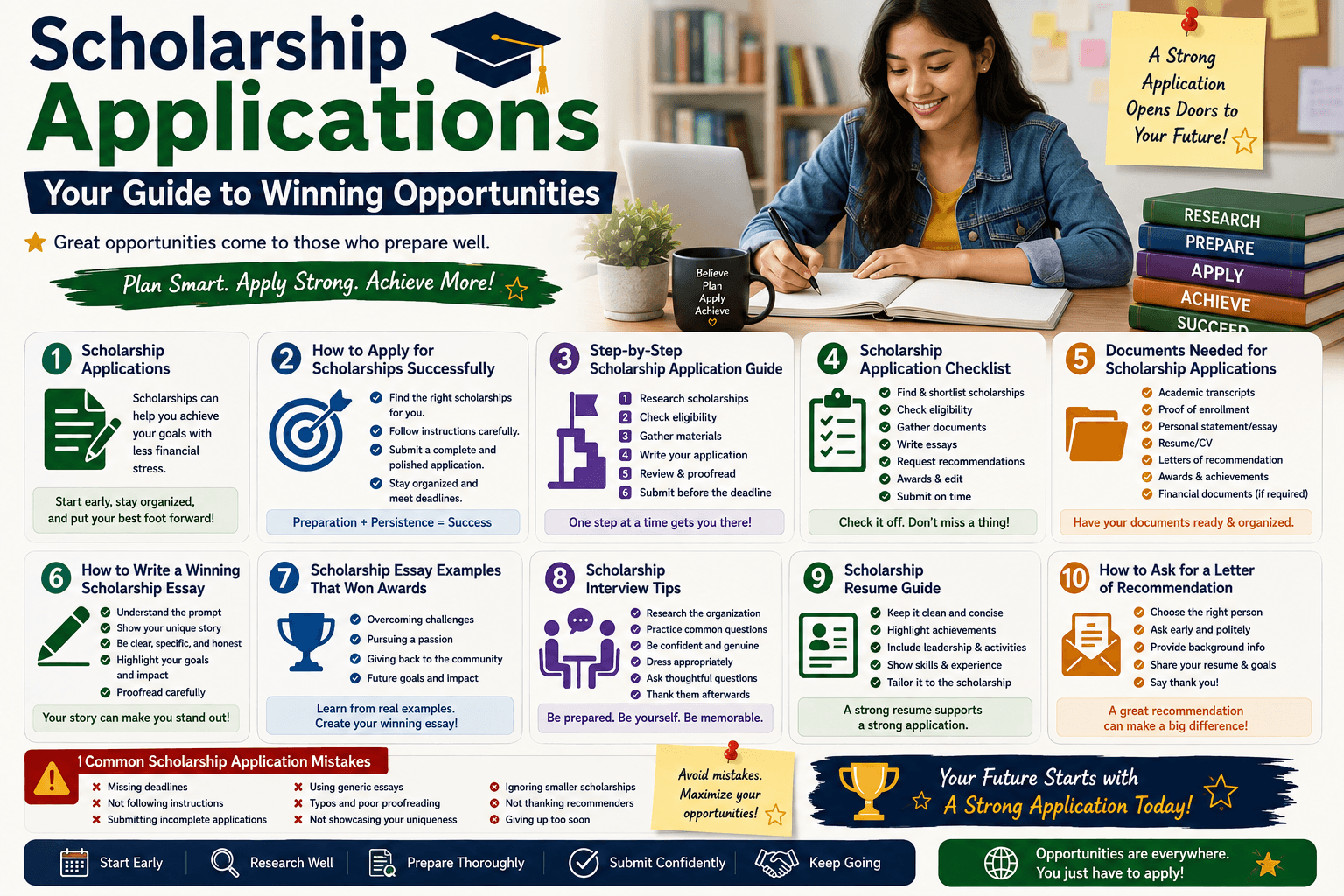
How to Apply for Scholarships Successfully
Landing a scholarship usually has little to do with chance — it’s really about careful preparation, precision, and a smart, targeted approach. The students who rack up the most scholarship wins aren’t always the top academic performers — they’re usually the ones who apply to the most opportunities and follow instructions carefully.
Several key practices consistently set winning applicants apart:
Begin well ahead of deadlines — scholarship committees can usually tell when an essay was written the night before.
Read every requirement carefully — missing a small detail, like a word count or file format, can disqualify an otherwise strong application.
Tailor each application individually — reviewers can almost always tell when an essay wasn’t written specifically for their program.
Submit to many programs at once — applying to more scholarships, including smaller local ones, significantly boosts your overall odds.
Step-by-Step Scholarship Application Guide
Use this basic roadmap for virtually any scholarship you apply to:
Search and select — gather a list of scholarships you’re eligible for, prioritizing ones that match your background, goals, or field of study.
Review criteria and due dates — write down every requirement and deadline, then organize them somewhere easy to check.
Gather your documents — whatever’s needed — grades, letters, financial paperwork — pull it together early.
Draft your essay or personal statement — budget real time for redrafting instead of submitting your first version.
Ask for references — give recommenders plenty of notice, ideally several weeks before the deadline.
Edit and double-check your materials — check for typos, formatting issues, and whether you’ve actually answered the prompt.
Submit before the deadline — give yourself buffer time before the cutoff in case something goes wrong.
Close the loop professionally — acknowledging the people who supported your application is a small gesture that matters.
Scholarship Application Checklist
A last-minute scan through this list can save you from costly mistakes:
Do you actually qualify based on every stated criterion?
Have all required documents been uploaded or attached?
Has anyone besides you checked your essay for errors?
Is your recommendation paperwork fully accounted for?
Does your application match the exact formatting requirements — word count, file type, font?
Is there any outdated contact info that needs fixing?
Are you turning this in with room to spare, not at the last second?
Documents Needed for Scholarship Applications
Most scholarships request a fairly predictable set of materials:
Official grade records — documentation verifying your classes and performance record.
A written essay — your opportunity to show, in your own words, why you’re a strong candidate.
Endorsement letters — typically from an educator, supervisor, or mentor familiar with your strengths.
CV or extracurricular summary — an overview of everything you’ve done — school, jobs, clubs, community service.
Proof of enrollment or acceptance — showing your current or upcoming enrollment status at a qualifying institution.
Financial documents (if need-based) — tax returns, income statements, or aid forms like the FAFSA, when required.
How to Write a Winning Scholarship Essay
Among everything you submit, the essay tends to matter most — it’s where your personality and story come through, not just your GPA.
What Makes an Essay Actually Win
Strong scholarship essays tend to share a few key traits:
A clear, specific story — rather than generic claims, show a particular experience that demonstrates the point.
Genuine voice over polish — reviewers read hundreds of essays and can spot a generic, overly polished response instantly.
A clear connection to your goals — connect your story directly to your academic or career ambitions.
Careful editing — even a compelling essay loses credibility with sloppy errors.
Scholarship Essay Examples That Won Awards
While every winning essay is different, most successful ones follow a similar structure: they hook the reader immediately with something specific and real. The essay then ties that moment to a broader insight, value, or personal shift. The strongest essays end by connecting the personal story directly to future plans and the award’s importance.
Recurring subjects in strong essays involve resilience, meaningful mentorship, a turning-point experience, or a responsibility that shaped who the applicant became. What matters isn’t the topic itself, but the specificity and honesty behind it.
Scholarship Interview Tips
Not every scholarship requires an interview, but for those that do, preparation matters enormously.
Be ready to discuss your own materials — be ready to speak in detail about your essay, activities, and goals, since interviewers often ask follow-up questions.
Prepare for predictable questions — expect standard prompts such as your career plans or why you’re a strong candidate.
Show up polished and prepared — treat every interview format with the same seriousness, video call or otherwise.
Show curiosity about the program — it signals real engagement and leaves a stronger final impression.
Scholarship Resume Guide
A scholarship resume looks a bit different from a job resume — the focus shifts toward school achievements, community involvement, and leadership rather than paid work history.
Keep it well-organized, ideally one page, with clear sections for academics, extracurricular activities, volunteer work, awards, and skills. Use strong action verbs and quantify achievements where possible — specific verbs and specific numbers always beat vague descriptions.
How to Ask for a Letter of Recommendation
This step often feels uncomfortable, but the right approach removes most of the anxiety.
Reach out well in advance — the earlier you ask, the more thoughtful and detailed the letter tends to be.
Choose someone who knows you well — someone who can speak to specific strengths or experiences, not just someone with a impressive title.
Give them useful material to work with — share your essay draft, key achievements, and details about the award itself.
Follow up politely — checking in respectfully, rather than repeatedly, keeps the relationship positive.
Say thank you — regardless of the outcome, a thank-you note is simply good etiquette.
Common Scholarship Application Mistakes
Even strong candidates lose out due to avoidable errors. Watch out for these common pitfalls:
Missing deadlines — most programs won’t even review a submission that arrives after the cutoff.
Skipping stated requirements — failing to follow exact formatting or content rules often results in automatic rejection.
Reusing the same essay for every application — reviewers can easily tell when an essay wasn’t tailored to their specific program.
Weak or rushed recommendation letters — last-minute requests often result in generic, unenthusiastic letters.
Poor proofreading — small errors can undercut an otherwise excellent application.
Applying too narrowly — focusing only on large, highly competitive national awards while ignoring smaller local ones with better odds.
The Bottom Line for Beginners
If there’s one lesson to take from this guide, it’s that scholarship applications reward preparation, not perfection. Begin well ahead of deadlines, stick closely to every requirement, write honestly and specifically, and submit to every reasonable opportunity you find. Winning scholarships often comes down to persistence and effort as much as raw qualifications.