Scholarship Applications: What Every Student Needs to Know
Filling out a scholarship application can feel like a maze of forms, essays, and deadlines. The sheer number of steps involved can leave anyone feeling a bit lost early on. The reassuring reality is this: once you understand the process, applying for scholarships becomes a repeatable, manageable skill.
Below, we’ll cover every essential piece — start to finish, from your first draft to your last thank-you note — equipping you to submit stronger applications and increase your real odds of success.
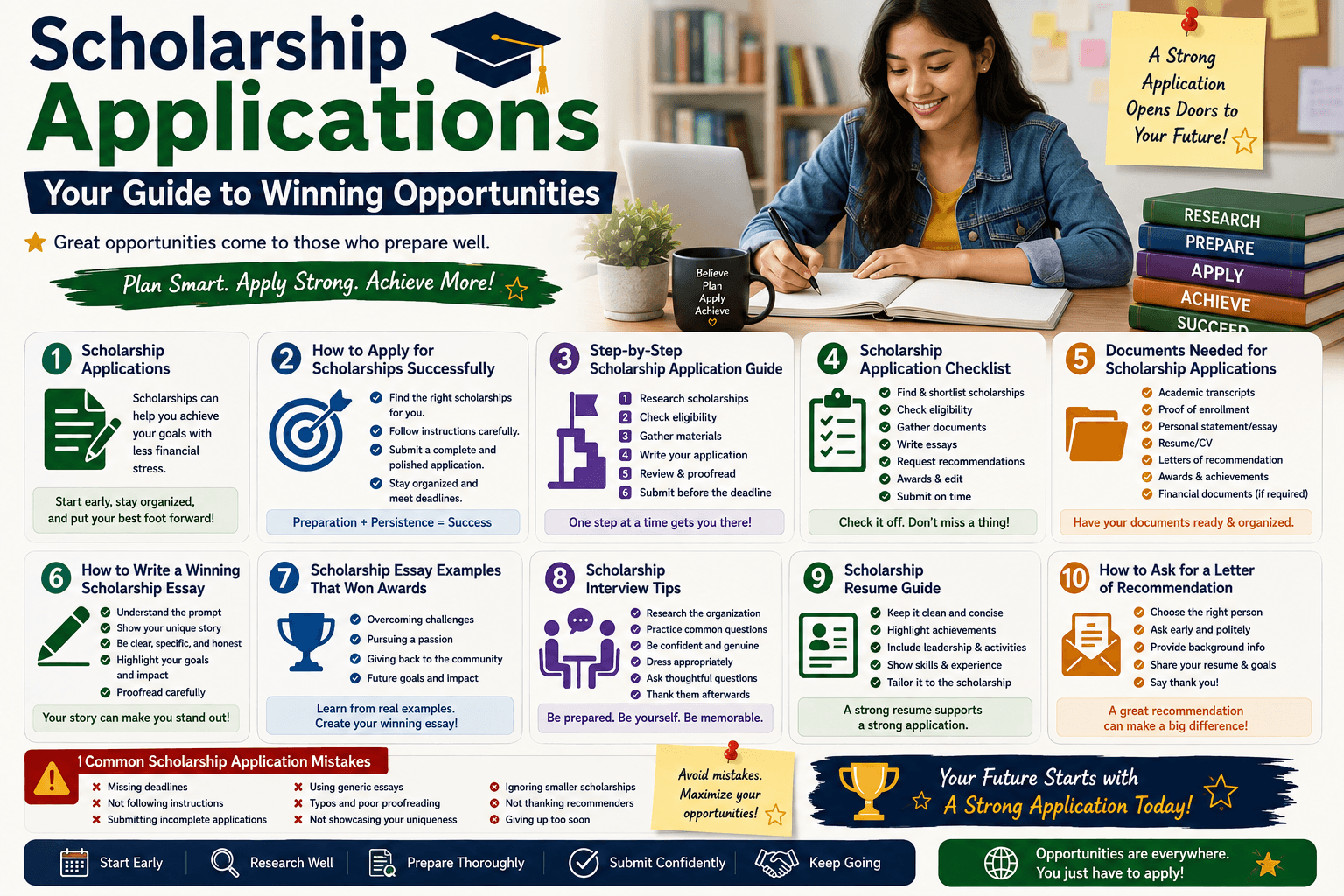
How to Apply for Scholarships Successfully
Landing a scholarship usually has little to do with chance — it’s really about careful preparation, precision, and a smart, targeted approach. The students who rack up the most scholarship wins aren’t always the top academic performers — they’re usually the ones who apply to the most opportunities and follow instructions carefully.
Several key practices consistently set winning applicants apart:
Start early — applications thrown together at the last minute almost always show it.
Study the guidelines closely — missing a small detail, like a word count or file format, can disqualify an otherwise strong application.
Personalize each application specifically — recycled, one-size-fits-all responses tend to stand out for the wrong reasons.
Cast a wide net — volume matters — smaller, local scholarships often have far less competition than big national ones.
Step-by-Step Scholarship Application Guide
Use this basic roadmap for virtually any scholarship you apply to:
Find and narrow down — build a list of eligible opportunities, weighting it toward programs that genuinely fit who you are.
Confirm eligibility and timing — note exactly what’s required and when it’s due, then build a simple tracking system.
Collect required paperwork — academic records, references, income documents, and any other requested files.
Draft your essay or personal statement — budget real time for redrafting instead of submitting your first version.
Request recommendation letters — give recommenders plenty of notice, ideally several weeks before the deadline.
Polish the entire application — look closely for grammar mistakes, formatting problems, and whether your essay truly addresses the question.
Send it in early, not at the last second — don’t wait until the final hour — technical glitches happen more often than you’d think.
Send a thank-you note when relevant — acknowledging the people who supported your application is a small gesture that matters.
Scholarship Application Checklist
Before you hit submit, run through this quick checklist:
Does your profile match all listed eligibility rules?
Are every one of the requested files actually included?
Has your essay been proofread by someone other than yourself?
Is your recommendation paperwork fully accounted for?
Does your application match the exact formatting requirements — word count, file type, font?
Is your contact information accurate and up to date?
Are you turning this in with room to spare, not at the last second?
Documents Needed for Scholarship Applications
While requirements vary, a familiar set of documents tends to reappear across applications:
School transcripts — documentation verifying your classes and performance record.
Personal statement — your chance to explain your goals, story, or why you deserve the award.
Endorsement letters — provided by someone who can speak credibly to your character and abilities.
CV or extracurricular summary — a snapshot of your involvement across academics, activities, and community work.
Proof of enrollment or acceptance — showing your current or upcoming enrollment status at a qualifying institution.
Financial need documentation — records such as tax filings or financial aid applications, if the scholarship is need-based.
How to Write a Winning Scholarship Essay
The essay is often the single most important part of a scholarship application — it’s your chance to stand out beyond grades and test scores.
What Makes an Essay Actually Win
Winning essays usually have several things in common:
One vivid, specific example — instead of vague statements like “I’ve always worked hard,” describe a specific moment that proves it.
Genuine voice over polish — judges have seen every cliché in the book, so genuine voice stands out.
A clear connection to your goals — connect your story directly to your academic or career ambitions.
Careful editing — small mistakes can undercut an otherwise excellent piece of writing.
Scholarship Essay Examples That Won Awards
Though topics differ widely, most winning essays follow a recognizable pattern: they open with a vivid, specific moment, not a generic statement. From there, they connect that moment to a lesson, value, or turning point. They close by linking the story to future ambitions and explaining the scholarship’s role in achieving them.
Recurring subjects in strong essays involve resilience, meaningful mentorship, a turning-point experience, or a responsibility that shaped who the applicant became. What matters isn’t the topic itself, but the specificity and honesty behind it.
Scholarship Interview Tips
Not every scholarship requires an interview, but for those that do, preparation matters enormously.
Know your own application — be ready to speak in detail about your essay, activities, and goals, since interviewers often ask follow-up questions.
Rehearse likely prompts — expect standard prompts such as your career plans or why you’re a strong candidate.
Show up polished and prepared — treat every interview format with the same seriousness, video call or otherwise.
Prepare a few genuine questions for the panel — it signals real engagement and leaves a stronger final impression.
Scholarship Resume Guide
A scholarship resume looks a bit different from a job resume — it should highlight academics, extracurriculars, volunteer work, and leadership rather than professional experience.
Structure it cleanly, aim for a single page, and use clearly labeled sections for school achievements, clubs, community service, honors, and relevant abilities. Lead with active language and include numbers whenever you can — specific verbs and specific numbers always beat vague descriptions.
How to Ask for a Letter of Recommendation
Asking for a recommendation letter can feel awkward, but a little strategy makes it much easier.
Give plenty of notice — a month’s notice, if possible, respects their schedule and results in a stronger letter.
Ask the right person — a person who genuinely knows your work, not simply the most senior name you can think of.
Provide context — share your essay draft, key achievements, and details about the award itself.
Check in respectfully as the deadline nears — checking in respectfully, rather than repeatedly, keeps the relationship positive.
Express genuine appreciation — whether or not you win, showing appreciation matters and is remembered.
Common Scholarship Application Mistakes
Even strong candidates lose out due to avoidable errors. Watch out for these common pitfalls:
Submitting late — most programs won’t even review a submission that arrives after the cutoff.
Ignoring instructions — small procedural errors are one of the most common, and avoidable, reasons applications get tossed out.
Reusing the same essay for every application — committees notice immediately when an applicant didn’t bother personalizing their response.
Weak or rushed recommendation letters — a hastily written letter from someone who barely knows you rarely helps your case.
Skipping the final review — a single unedited draft rarely represents your best possible work.
Only going for the “big” scholarships — focusing only on large, highly competitive national awards while ignoring smaller local ones with better odds.
The Bottom Line for Beginners
If there’s one lesson to take from this guide, it’s that scholarship applications reward preparation, not perfection. Give yourself time, respect every guideline, be authentic in your writing, and cast as wide a net as realistically possible. Winning scholarships often comes down to persistence and effort as much as raw qualifications.