Scholarship Applications: What Every Student Needs to Know
Filling out a scholarship application can feel like a maze of forms, essays, and deadlines. Between essays, documents, deadlines, and requirements, it’s easy to feel lost. But here’s the truth: breaking the process into clear steps turns something intimidating into something completely doable.
Below, we’ll cover every essential piece — from the very first step to the final follow-up — giving you the confidence and strategy needed to genuinely boost your chances.
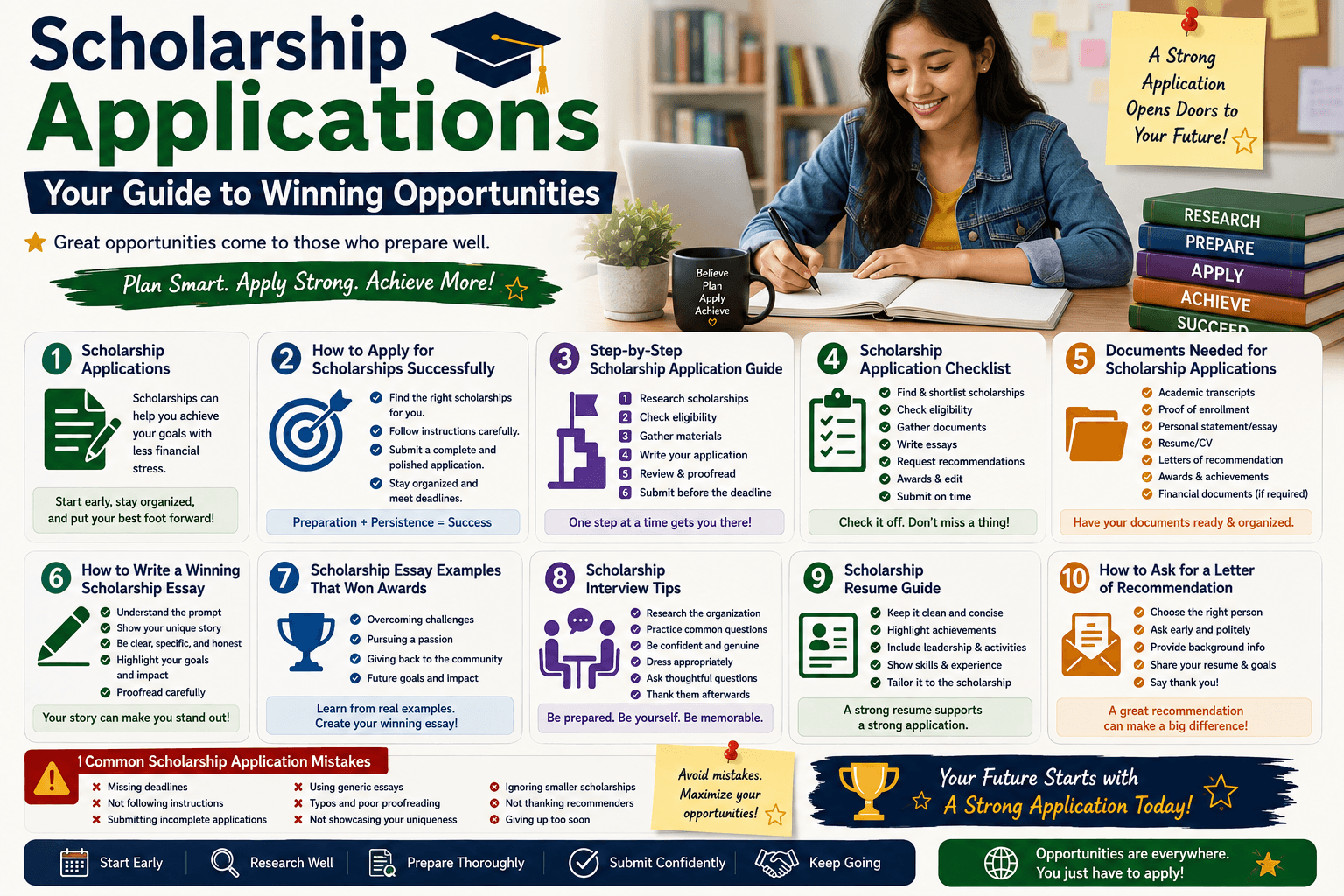
How to Apply for Scholarships Successfully
Landing a scholarship usually has little to do with chance — it’s really about careful preparation, precision, and a smart, targeted approach. It’s not always the highest-achieving students who collect the most awards — more often, they’re simply the ones who apply widely and follow every guideline precisely.
A few core habits separate successful applicants from everyone else:
Get going long before due dates — rushed applications are noticeably weaker, and last-minute essays rarely shine.
Read every requirement carefully — overlooking something minor, like formatting rules, can knock out an application that would’ve otherwise been competitive.
Customize every submission — reviewers can almost always tell when an essay wasn’t written specifically for their program.
Apply broadly — applying to more scholarships, including smaller local ones, significantly boosts your overall odds.
Step-by-Step Scholarship Application Guide
This straightforward sequence works for almost every scholarship program you’ll encounter:
Find and narrow down — build a list of eligible opportunities, weighting it toward programs that genuinely fit who you are.
Check requirements and deadlines — write down every requirement and deadline, then organize them somewhere easy to check.
Collect required paperwork — whatever’s needed — grades, letters, financial paperwork — pull it together early.
Compose your personal statement — give yourself enough time to write multiple drafts, not just one rushed version.
Ask for references — reach out well in advance, giving your references weeks rather than days.
Review and proofread everything — scan for errors and confirm every part of the prompt has genuinely been addressed.
Send it in early, not at the last second — give yourself buffer time before the cutoff in case something goes wrong.
Send a thank-you note when relevant — acknowledging the people who supported your application is a small gesture that matters.
Scholarship Application Checklist
Use this rapid checklist right before you finalize anything:
Have you met every eligibility requirement?
Have all required documents been uploaded or attached?
Has your essay been proofread by someone other than yourself?
Have your references actually turned in their letters?
Did you double-check the technical specs, like word limits and accepted file types?
Is there any outdated contact info that needs fixing?
Are you turning this in with room to spare, not at the last second?
Documents Needed for Scholarship Applications
Nearly every scholarship application draws from the same general pool of paperwork:
Academic transcripts — official records showing what you’ve studied and how you’ve performed.
A written essay — the section where you make your case — your background, ambitions, and motivations.
Endorsement letters — written by teachers, mentors, employers, or coaches who know your work well.
List of achievements and activities — a snapshot of your involvement across academics, activities, and community work.
Admission confirmation — showing your current or upcoming enrollment status at a qualifying institution.
Financial documents (if need-based) — paperwork proving household income, typically required only for need-based awards.
How to Write a Winning Scholarship Essay
The essay is often the single most important part of a scholarship application — it’s your chance to stand out beyond grades and test scores.
What Makes an Essay Actually Win
Strong scholarship essays tend to share a few key traits:
A clear, specific story — specificity beats generality every time — one real story outperforms ten vague claims.
Honesty over impressiveness — committee members notice immediately when an essay feels rehearsed or inauthentic.
A direct link to your future plans — explain not just what happened to you, but how it shapes where you’re headed.
Careful editing — typos and grammar mistakes signal carelessness, even if the content itself is strong.
Scholarship Essay Examples That Won Awards
Though topics differ widely, most winning essays follow a recognizable pattern: they begin with a concrete scene or detail rather than a broad opening line. The essay then ties that moment to a broader insight, value, or personal shift. They close by linking the story to future ambitions and explaining the scholarship’s role in achieving them.
Common winning topics include overcoming a specific challenge, a formative experience with a mentor, a moment that shifted a career goal, or a personal responsibility that shaped the applicant’s character. It’s not about picking a dramatic topic — it’s about telling any topic with real honesty and detail.
Scholarship Interview Tips
When an interview is part of the process, thorough preparation can make or break your chances.
Know your own application — interviewers frequently probe deeper into your application, so know your own answers inside and out.
Practice common questions — questions like “why do you deserve this scholarship” or “what are your future goals” come up often.
Treat it like a real interview — treat every interview format with the same seriousness, video call or otherwise.
Show curiosity about the program — it signals real engagement and leaves a stronger final impression.
Scholarship Resume Guide
Unlike a professional resume, a scholarship resume has its own format — the focus shifts toward school achievements, community involvement, and leadership rather than paid work history.
Structure it cleanly, aim for a single page, and use clearly labeled sections for academics, extracurricular activities, volunteer work, awards, and skills. Favor active, specific language, and back up claims with real numbers when possible — precision in both language and figures makes a resume far more convincing.
How to Ask for a Letter of Recommendation
Asking for a recommendation letter can feel awkward, but a little strategy makes it much easier.
Give plenty of notice — a month’s notice, if possible, respects their schedule and results in a stronger letter.
Ask the right person — choose depth of relationship over prestige of title.
Provide context — hand them everything they need — your goals, the scholarship’s focus, and relevant accomplishments.
Send a gentle reminder if needed — checking in respectfully, rather than repeatedly, keeps the relationship positive.
Say thank you — regardless of the outcome, a thank-you note is simply good etiquette.
Common Scholarship Application Mistakes
Even strong candidates lose out due to avoidable errors. Here are the mistakes that show up again and again:
Waiting until the last minute — most programs won’t even review a submission that arrives after the cutoff.
Overlooking specific guidelines — wrong word counts, missing sections, or incorrect file formats can lead to instant disqualification.
Submitting a one-size-fits-all response — committees notice immediately when an applicant didn’t bother personalizing their response.
Choosing the wrong recommender — a hastily written letter from someone who barely knows you rarely helps your case.
Submitting work full of typos — small errors can undercut an otherwise excellent application.
Applying too narrowly — overlooking modest local awards is one of the most common strategic mistakes applicants make.
The Bottom Line for Beginners
More than anything, remember this — thorough preparation matters far more than a flawless application. Start early, follow instructions exactly, tell a genuine and specific story in your essay, and apply to as many legitimate opportunities as you reasonably can. It’s not always the strongest résumé that wins — frequently, it’s simply the applicant who showed up and applied.