Scholarship Applications: What Every Student Needs to Know
Sitting down to complete a scholarship application can seem like a maze of forms, essays, and deadlines. Between essays, documents, deadlines, and requirements, it’s easy to feel lost. The reassuring reality is this: the scholarship application process gets far easier once you know what to expect.
What follows breaks down each part of the process — from the very first step to the final follow-up — giving you the confidence and strategy needed to genuinely boost your chances.
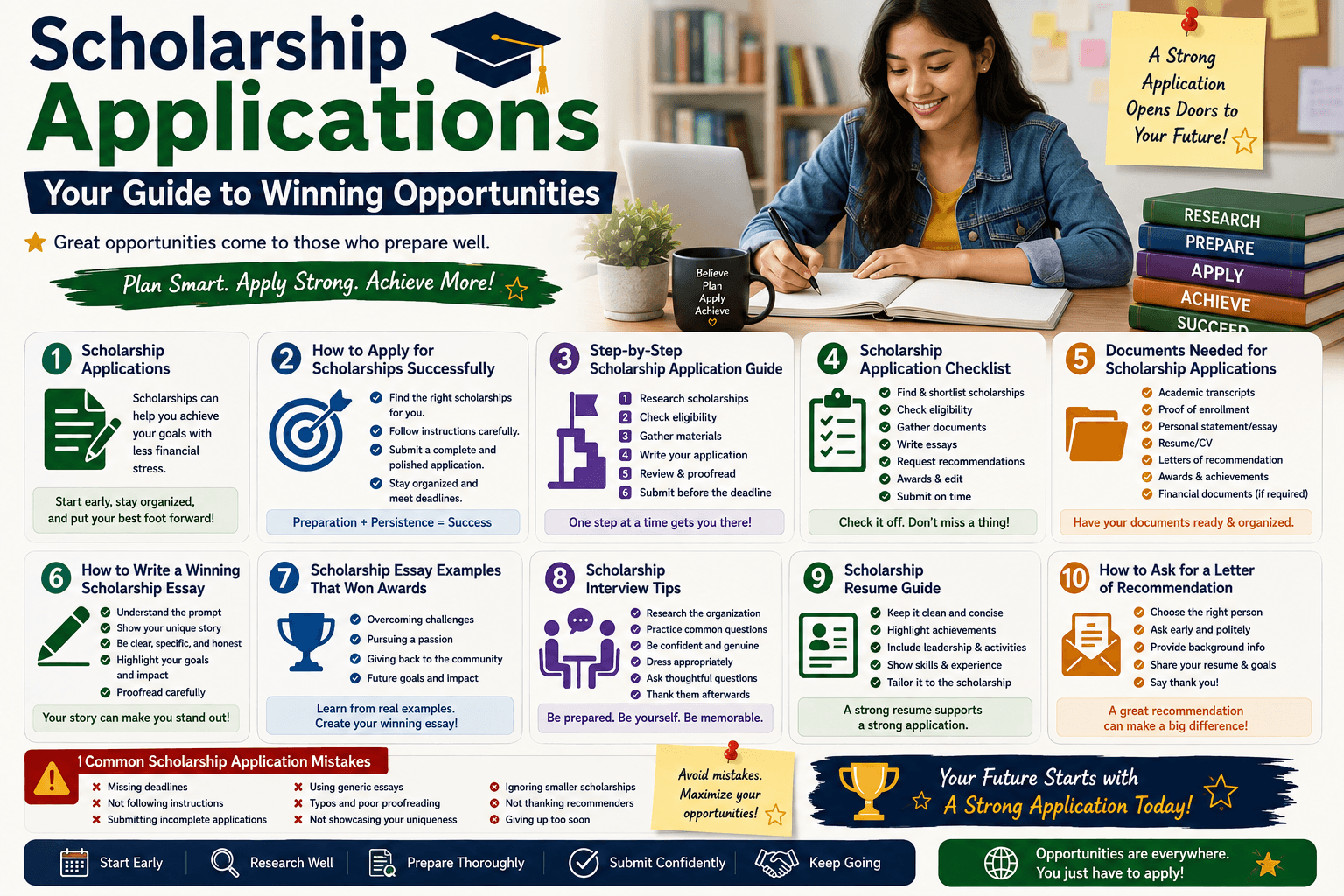
How to Apply for Scholarships Successfully
Winning scholarships is far less about luck than most people assume — it’s really about careful preparation, precision, and a smart, targeted approach. It’s not always the highest-achieving students who collect the most awards — more often, they’re simply the ones who apply widely and follow every guideline precisely.
A few core habits separate successful applicants from everyone else:
Start early — applications thrown together at the last minute almost always show it.
Study the guidelines closely — missing a small detail, like a word count or file format, can disqualify an otherwise strong application.
Tailor each application individually — recycled, one-size-fits-all responses tend to stand out for the wrong reasons.
Cast a wide net — volume matters — smaller, local scholarships often have far less competition than big national ones.
Step-by-Step Scholarship Application Guide
This straightforward sequence works for almost every scholarship program you’ll encounter:
Find and narrow down — gather a list of scholarships you’re eligible for, prioritizing ones that match your background, goals, or field of study.
Check requirements and deadlines — note exactly what’s required and when it’s due, then build a simple tracking system.
Assemble your materials — transcripts, recommendation letters, financial forms, and anything else the application asks for.
Compose your personal statement — plan for several rounds of revision rather than a single first attempt.
Request recommendation letters — approach potential recommenders early, respecting their time and workload.
Review and proofread everything — look closely for grammar mistakes, formatting problems, and whether your essay truly addresses the question.
Finalize and turn in your application — give yourself buffer time before the cutoff in case something goes wrong.
Follow up if appropriate — a short thank-you note to recommenders or interviewers leaves a lasting positive impression.
Scholarship Application Checklist
Use this rapid checklist right before you finalize anything:
Do you actually qualify based on every stated criterion?
Are every one of the requested files actually included?
Has anyone besides you checked your essay for errors?
Is your recommendation paperwork fully accounted for?
Have you followed every formatting rule precisely — length limits, file format, required font?
Have you confirmed your email and phone number are current?
Did you leave yourself cushion time before the true cutoff?
Documents Needed for Scholarship Applications
Most scholarships request a fairly predictable set of materials:
Academic transcripts — documentation verifying your classes and performance record.
Personal statement — your chance to explain your goals, story, or why you deserve the award.
Endorsement letters — written by teachers, mentors, employers, or coaches who know your work well.
Resume or activity list — a summary of your academic, extracurricular, work, and volunteer experience.
Proof of enrollment or acceptance — confirming you’re enrolled in, or accepted to, an eligible school or program.
Financial documents (if need-based) — paperwork proving household income, typically required only for need-based awards.
How to Write a Winning Scholarship Essay
Nothing in the application usually carries more weight than the essay — it’s the one section where numbers take a back seat to who you actually are.
What Makes an Essay Actually Win
The most successful essays consistently follow a similar pattern:
A clear, specific story — rather than generic claims, show a particular experience that demonstrates the point.
Honesty over impressiveness — reviewers read hundreds of essays and can spot a generic, overly polished response instantly.
A clear connection to your goals — connect your story directly to your academic or career ambitions.
Multiple rounds of proofreading — typos and grammar mistakes signal carelessness, even if the content itself is strong.
Scholarship Essay Examples That Won Awards
While every winning essay is different, most successful ones follow a similar structure: they open with a vivid, specific moment, not a generic statement. The essay then ties that moment to a broader insight, value, or personal shift. Finally, they tie everything back to the applicant’s future goals and why the scholarship matters.
Frequent themes among award-winning essays include hardship overcome, a pivotal mentorship, a career-defining moment, or a responsibility that built character. It’s not about picking a dramatic topic — it’s about telling any topic with real honesty and detail.
Scholarship Interview Tips
When an interview is part of the process, thorough preparation can make or break your chances.
Review everything you submitted — expect follow-up questions on anything you wrote, so revisit your essay and resume beforehand.
Rehearse likely prompts — typical questions revolve around your goals, motivations, and reasons for applying.
Dress and present professionally — treat every interview format with the same seriousness, video call or otherwise.
Ask thoughtful questions of your own — it signals real engagement and leaves a stronger final impression.
Scholarship Resume Guide
A scholarship resume looks a bit different from a job resume — it should highlight academics, extracurriculars, volunteer work, and leadership rather than professional experience.
Organize it tightly — one page is ideal — with distinct, easy-to-scan categories for academics, extracurricular activities, volunteer work, awards, and skills. Use strong action verbs and quantify achievements where possible — “organized” rather than “helped with,” “raised $2,000” rather than “raised money”.
How to Ask for a Letter of Recommendation
This step often feels uncomfortable, but the right approach removes most of the anxiety.
Reach out well in advance — a month’s notice, if possible, respects their schedule and results in a stronger letter.
Ask the right person — a person who genuinely knows your work, not simply the most senior name you can think of.
Provide context — share your essay draft, key achievements, and details about the award itself.
Send a gentle reminder if needed — checking in respectfully, rather than repeatedly, keeps the relationship positive.
Say thank you — a sincere thank-you leaves a lasting, positive impression either way.
Common Scholarship Application Mistakes
Some of the most competitive students still lose scholarships over simple, fixable mistakes. Here are the mistakes that show up again and again:
Missing deadlines — late applications are almost always rejected outright, no exceptions.
Overlooking specific guidelines — wrong word counts, missing sections, or incorrect file formats can lead to instant disqualification.
Reusing the same essay for every application — reviewers can easily tell when an essay wasn’t tailored to their specific program.
Asking recommenders at the last minute — last-minute requests often result in generic, unenthusiastic letters.
Submitting work full of typos — a single unedited draft rarely represents your best possible work.
Ignoring smaller, local opportunities — overlooking modest local awards is one of the most common strategic mistakes applicants make.
The Bottom Line for Beginners
If there’s one lesson to take from this guide, it’s that scholarship applications reward preparation, not perfection. Start early, follow instructions exactly, tell a genuine and specific story in your essay, and apply to as many legitimate opportunities as you reasonably can. Winning scholarships often comes down to persistence and effort as much as raw qualifications.