Scholarship Applications: What Every Student Needs to Know
Sitting down to complete a scholarship application can seem like a maze of forms, essays, and deadlines. Between essays, documents, deadlines, and requirements, it’s easy to feel lost. But here’s the truth: the scholarship application process gets far easier once you know what to expect.
What follows breaks down each part of the process — beginning with preparation and ending with post-application etiquette — giving you the confidence and strategy needed to genuinely boost your chances.
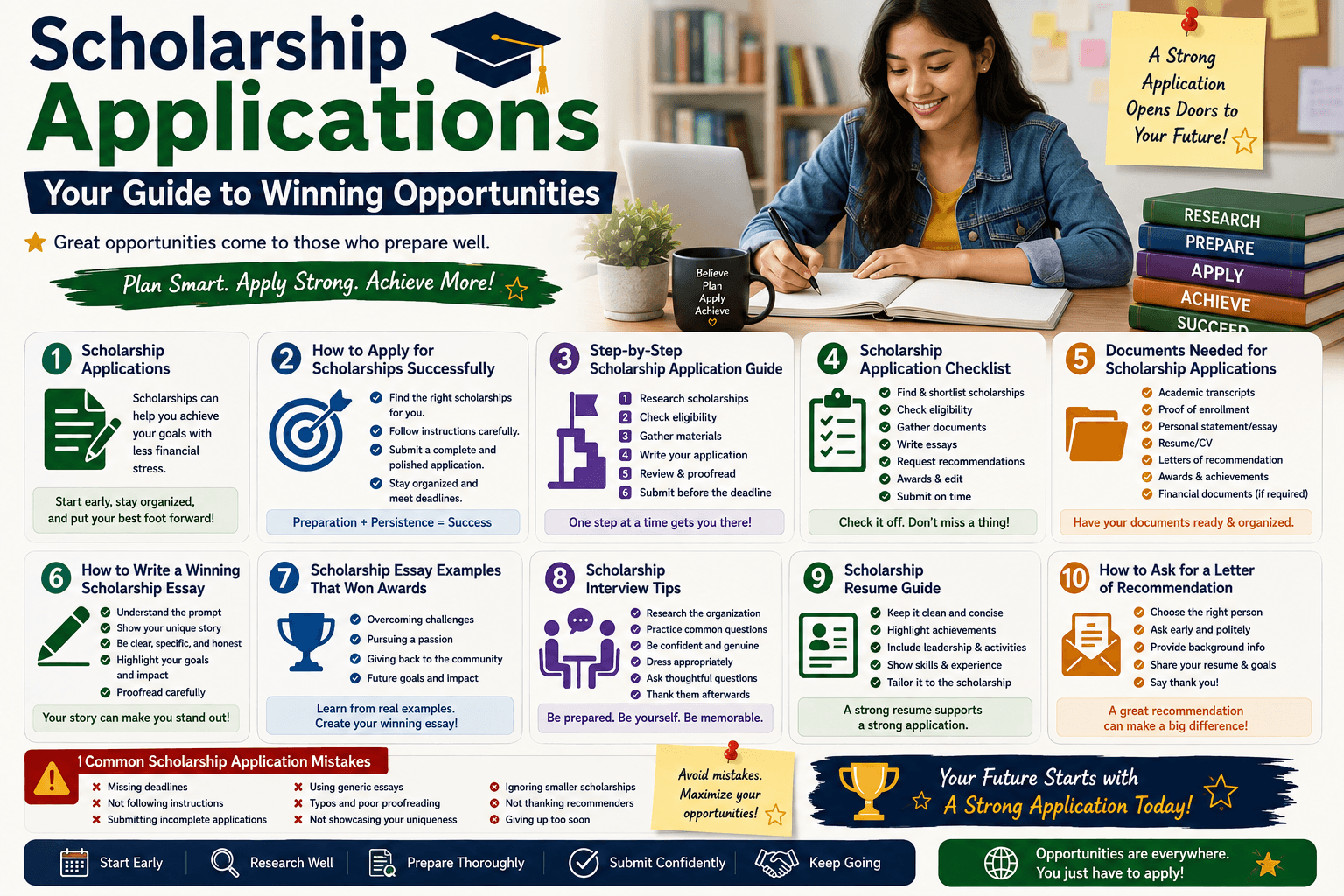
How to Apply for Scholarships Successfully
Winning scholarships is far less about luck than most people assume — it hinges on thorough prep work, attention to small details, and a deliberate strategy. The students who win the most scholarships aren’t necessarily the smartest — they’re usually the ones who apply to the most opportunities and follow instructions carefully.
A handful of consistent habits tend to define the most successful candidates:
Begin well ahead of deadlines — scholarship committees can usually tell when an essay was written the night before.
Pay close attention to every instruction — small oversights — wrong file type, missed word limit — are surprisingly common reasons for disqualification.
Tailor each application individually — recycled, one-size-fits-all responses tend to stand out for the wrong reasons.
Cast a wide net — applying to more scholarships, including smaller local ones, significantly boosts your overall odds.
Step-by-Step Scholarship Application Guide
This straightforward sequence works for almost every scholarship program you’ll encounter:
Search and select — build a list of eligible opportunities, weighting it toward programs that genuinely fit who you are.
Confirm eligibility and timing — write down every requirement and deadline, then organize them somewhere easy to check.
Collect required paperwork — whatever’s needed — grades, letters, financial paperwork — pull it together early.
Write your application essay — plan for several rounds of revision rather than a single first attempt.
Request recommendation letters — reach out well in advance, giving your references weeks rather than days.
Edit and double-check your materials — look closely for grammar mistakes, formatting problems, and whether your essay truly addresses the question.
Finalize and turn in your application — aim to submit at least a day or two early in case of technical issues.
Send a thank-you note when relevant — acknowledging the people who supported your application is a small gesture that matters.
Scholarship Application Checklist
Before you hit submit, run through this quick checklist:
Have you met every eligibility requirement?
Are every one of the requested files actually included?
Has your essay been proofread by someone other than yourself?
Have your references actually turned in their letters?
Did you double-check the technical specs, like word limits and accepted file types?
Is there any outdated contact info that needs fixing?
Did you leave yourself cushion time before the true cutoff?
Documents Needed for Scholarship Applications
Most scholarships request a fairly predictable set of materials:
Official grade records — documentation verifying your classes and performance record.
Personal statement — your chance to explain your goals, story, or why you deserve the award.
Endorsement letters — written by teachers, mentors, employers, or coaches who know your work well.
Resume or activity list — a summary of your academic, extracurricular, work, and volunteer experience.
Admission confirmation — confirming you’re enrolled in, or accepted to, an eligible school or program.
Income verification paperwork — records such as tax filings or financial aid applications, if the scholarship is need-based.
How to Write a Winning Scholarship Essay
Among everything you submit, the essay tends to matter most — it’s your chance to stand out beyond grades and test scores.
What Makes an Essay Actually Win
Strong scholarship essays tend to share a few key traits:
A clear, specific story — rather than generic claims, show a particular experience that demonstrates the point.
Genuine voice over polish — judges have seen every cliché in the book, so genuine voice stands out.
An obvious tie to why the award matters — explain not just what happened to you, but how it shapes where you’re headed.
Careful editing — even a compelling essay loses credibility with sloppy errors.
Scholarship Essay Examples That Won Awards
Though topics differ widely, most winning essays follow a recognizable pattern: they begin with a concrete scene or detail rather than a broad opening line. The narrative moves from that specific detail toward a larger realization or change. Finally, they tie everything back to the applicant’s future goals and why the scholarship matters.
Recurring subjects in strong essays involve resilience, meaningful mentorship, a turning-point experience, or a responsibility that shaped who the applicant became. What matters isn’t the topic itself, but the specificity and honesty behind it.
Scholarship Interview Tips
When an interview is part of the process, thorough preparation can make or break your chances.
Know your own application — expect follow-up questions on anything you wrote, so revisit your essay and resume beforehand.
Prepare for predictable questions — questions like “why do you deserve this scholarship” or “what are your future goals” come up often.
Show up polished and prepared — whether online or face-to-face, professionalism matters just as much.
Show curiosity about the program — it signals real engagement and leaves a stronger final impression.
Scholarship Resume Guide
Unlike a professional resume, a scholarship resume has its own format — it centers on academic and community contributions instead of formal employment.
Keep it well-organized, ideally one page, with clear sections for academics, extracurricular activities, volunteer work, awards, and skills. Use strong action verbs and quantify achievements where possible — specific verbs and specific numbers always beat vague descriptions.
How to Ask for a Letter of Recommendation
Asking for a recommendation letter can feel awkward, but a little strategy makes it much easier.
Reach out well in advance — a month’s notice, if possible, respects their schedule and results in a stronger letter.
Ask the right person — choose depth of relationship over prestige of title.
Give them useful material to work with — share your essay draft, key achievements, and details about the award itself.
Check in respectfully as the deadline nears — checking in respectfully, rather than repeatedly, keeps the relationship positive.
Close the loop with gratitude — a sincere thank-you leaves a lasting, positive impression either way.
Common Scholarship Application Mistakes
Even strong candidates lose out due to avoidable errors. Watch out for these common pitfalls:
Waiting until the last minute — deadlines in scholarship applications are rarely, if ever, flexible.
Ignoring instructions — small procedural errors are one of the most common, and avoidable, reasons applications get tossed out.
Generic, copy-pasted essays — committees notice immediately when an applicant didn’t bother personalizing their response.
Choosing the wrong recommender — a hastily written letter from someone who barely knows you rarely helps your case.
Skipping the final review — a single unedited draft rarely represents your best possible work.
Applying too narrowly — focusing only on large, highly competitive national awards while ignoring smaller local ones with better odds.
The Bottom Line for Beginners
If there’s one lesson to take from this guide, it’s that scholarship applications reward preparation, not perfection. Start early, follow instructions exactly, tell a genuine and specific story in your essay, and apply to as many legitimate opportunities as you reasonably can. It’s not always the strongest résumé that wins — frequently, it’s simply the applicant who showed up and applied.