Scholarship Applications: What Every Student Needs to Know
Tackling a scholarship application often feels overwhelming, confusing, or even a little intimidating at first. With so many moving parts — essays, paperwork, due dates — confusion is completely normal. But here’s the truth: breaking the process into clear steps turns something intimidating into something completely doable.
What follows breaks down each part of the process — start to finish, from your first draft to your last thank-you note — so you can apply with confidence and actually improve your odds of winning.
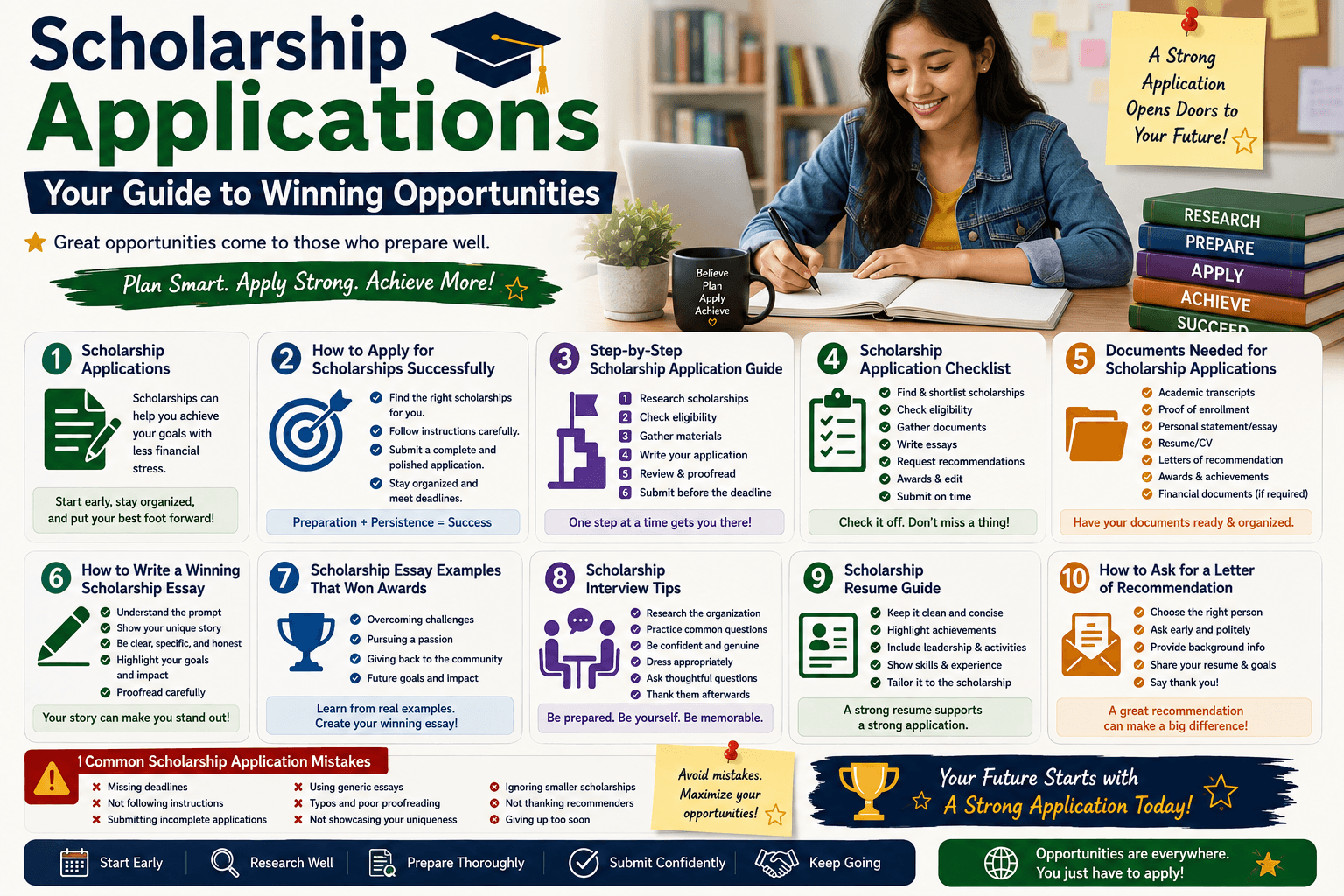
How to Apply for Scholarships Successfully
Success with scholarship applications rarely comes down to luck — it comes down to preparation, attention to detail, and applying strategically. The students who win the most scholarships aren’t necessarily the smartest — they’re usually the ones who apply to the most opportunities and follow instructions carefully.
A handful of consistent habits tend to define the most successful candidates:
Start early — rushed applications are noticeably weaker, and last-minute essays rarely shine.
Pay close attention to every instruction — missing a small detail, like a word count or file format, can disqualify an otherwise strong application.
Tailor each application individually — recycled, one-size-fits-all responses tend to stand out for the wrong reasons.
Cast a wide net — volume matters — smaller, local scholarships often have far less competition than big national ones.
Step-by-Step Scholarship Application Guide
This straightforward sequence works for almost every scholarship program you’ll encounter:
Find and narrow down — compile scholarships you qualify for, focusing on those aligned with your interests, major, or personal story.
Confirm eligibility and timing — write down every requirement and deadline, then organize them somewhere easy to check.
Collect required paperwork — whatever’s needed — grades, letters, financial paperwork — pull it together early.
Draft your essay or personal statement — give yourself enough time to write multiple drafts, not just one rushed version.
Request recommendation letters — reach out well in advance, giving your references weeks rather than days.
Edit and double-check your materials — scan for errors and confirm every part of the prompt has genuinely been addressed.
Submit before the deadline — give yourself buffer time before the cutoff in case something goes wrong.
Close the loop professionally — a short thank-you note to recommenders or interviewers leaves a lasting positive impression.
Scholarship Application Checklist
Use this rapid checklist right before you finalize anything:
Have you met every eligibility requirement?
Have all required documents been uploaded or attached?
Has your essay been proofread by someone other than yourself?
Is your recommendation paperwork fully accounted for?
Did you double-check the technical specs, like word limits and accepted file types?
Have you confirmed your email and phone number are current?
Did you leave yourself cushion time before the true cutoff?
Documents Needed for Scholarship Applications
Most scholarships request a fairly predictable set of materials:
Official grade records — official records showing what you’ve studied and how you’ve performed.
Personal statement — the section where you make your case — your background, ambitions, and motivations.
Reference letters — provided by someone who can speak credibly to your character and abilities.
List of achievements and activities — a snapshot of your involvement across academics, activities, and community work.
Admission confirmation — confirming you’re enrolled in, or accepted to, an eligible school or program.
Income verification paperwork — tax returns, income statements, or aid forms like the FAFSA, when required.
How to Write a Winning Scholarship Essay
Among everything you submit, the essay tends to matter most — it’s your chance to stand out beyond grades and test scores.
What Makes an Essay Actually Win
Strong scholarship essays tend to share a few key traits:
A focused, concrete narrative — specificity beats generality every time — one real story outperforms ten vague claims.
Authenticity over perfection — judges have seen every cliché in the book, so genuine voice stands out.
A clear connection to your goals — explain not just what happened to you, but how it shapes where you’re headed.
Multiple rounds of proofreading — even a compelling essay loses credibility with sloppy errors.
Scholarship Essay Examples That Won Awards
Though topics differ widely, most winning essays follow a recognizable pattern: they hook the reader immediately with something specific and real. The essay then ties that moment to a broader insight, value, or personal shift. They close by linking the story to future ambitions and explaining the scholarship’s role in achieving them.
Recurring subjects in strong essays involve resilience, meaningful mentorship, a turning-point experience, or a responsibility that shaped who the applicant became. It’s not about picking a dramatic topic — it’s about telling any topic with real honesty and detail.
Scholarship Interview Tips
When an interview is part of the process, thorough preparation can make or break your chances.
Be ready to discuss your own materials — interviewers frequently probe deeper into your application, so know your own answers inside and out.
Practice common questions — expect standard prompts such as your career plans or why you’re a strong candidate.
Show up polished and prepared — even a virtual interview deserves the same level of preparation as an in-person one.
Prepare a few genuine questions for the panel — it signals real engagement and leaves a stronger final impression.
Scholarship Resume Guide
Scholarship resumes follow slightly different rules than typical job-application resumes — it should highlight academics, extracurriculars, volunteer work, and leadership rather than professional experience.
Keep it well-organized, ideally one page, with clear sections for coursework, activities, service work, recognitions, and useful skills. Lead with active language and include numbers whenever you can — specific verbs and specific numbers always beat vague descriptions.
How to Ask for a Letter of Recommendation
This step often feels uncomfortable, but the right approach removes most of the anxiety.
Ask early — a month’s notice, if possible, respects their schedule and results in a stronger letter.
Ask the right person — a person who genuinely knows your work, not simply the most senior name you can think of.
Provide context — send your resume, the scholarship description, and a few points you’d love them to mention.
Check in respectfully as the deadline nears — a brief, courteous reminder a week before the deadline is completely appropriate.
Say thank you — regardless of the outcome, a thank-you note is simply good etiquette.
Common Scholarship Application Mistakes
Even strong candidates lose out due to avoidable errors. Watch out for these common pitfalls:
Missing deadlines — deadlines in scholarship applications are rarely, if ever, flexible.
Ignoring instructions — failing to follow exact formatting or content rules often results in automatic rejection.
Submitting a one-size-fits-all response — a recycled essay rarely resonates the way a customized one does.
Asking recommenders at the last minute — last-minute requests often result in generic, unenthusiastic letters.
Submitting work full of typos — small errors can undercut an otherwise excellent application.
Ignoring smaller, local opportunities — chasing only the most famous scholarships while skipping smaller programs with far less competition.
The Bottom Line for Beginners
The clearest takeaway here is simple: preparation beats perfection every time. Start early, follow instructions exactly, tell a genuine and specific story in your essay, and apply to as many legitimate opportunities as you reasonably can. Winning scholarships often comes down to persistence and effort as much as raw qualifications.