Scholarship Applications: What Every Student Needs to Know
Sitting down to complete a scholarship application can seem overwhelming, confusing, or even a little intimidating at first. With so many moving parts — essays, paperwork, due dates — confusion is completely normal. The reassuring reality is this: the scholarship application process gets far easier once you know what to expect.
This guide walks through everything you need — start to finish, from your first draft to your last thank-you note — equipping you to submit stronger applications and increase your real odds of success.
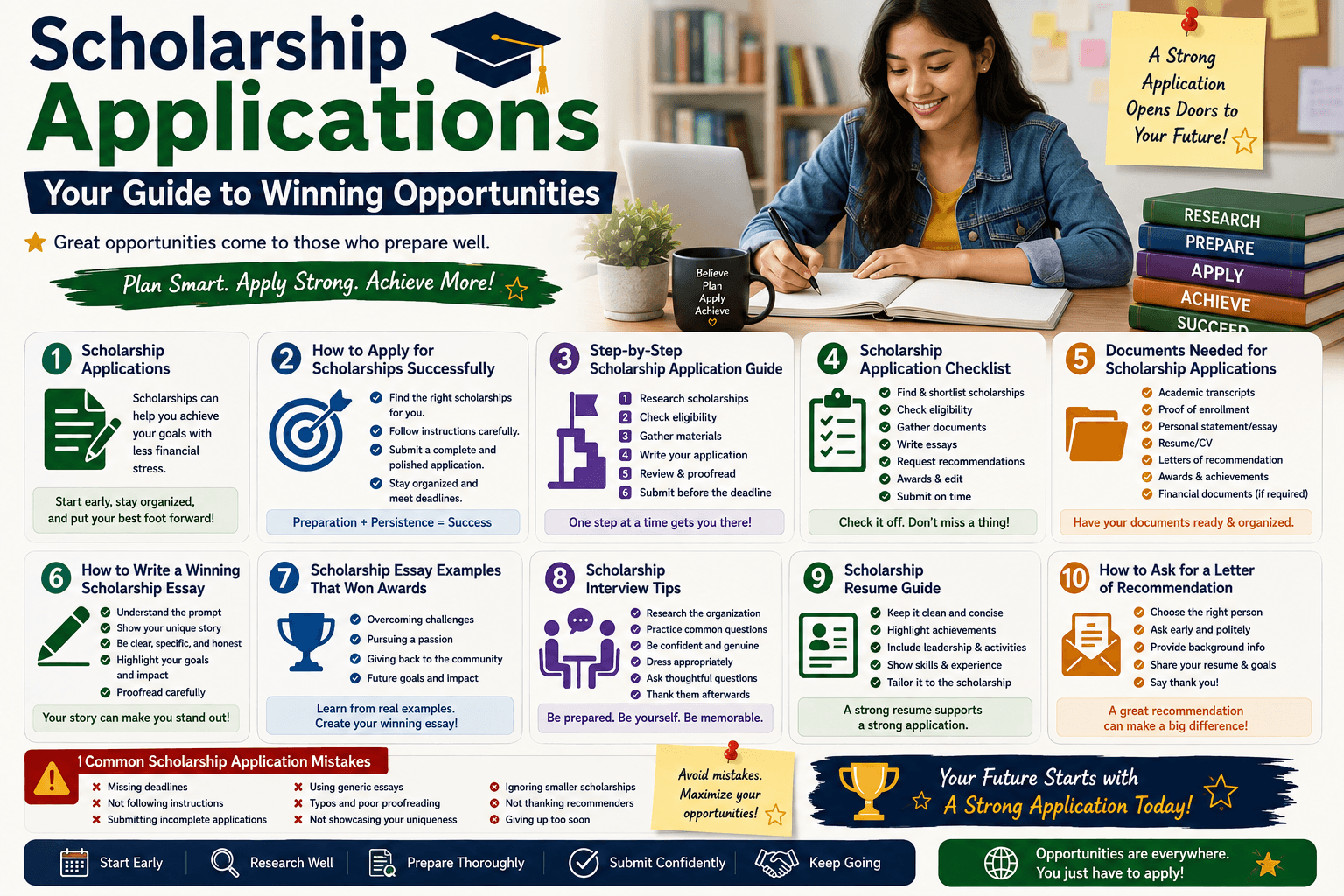
How to Apply for Scholarships Successfully
Success with scholarship applications rarely comes down to luck — it’s really about careful preparation, precision, and a smart, targeted approach. It’s not always the highest-achieving students who collect the most awards — more often, they’re simply the ones who apply widely and follow every guideline precisely.
A handful of consistent habits tend to define the most successful candidates:
Get going long before due dates — scholarship committees can usually tell when an essay was written the night before.
Study the guidelines closely — small oversights — wrong file type, missed word limit — are surprisingly common reasons for disqualification.
Customize every submission — generic, copy-pasted answers are easy for reviewers to spot.
Cast a wide net — volume matters — smaller, local scholarships often have far less competition than big national ones.
Step-by-Step Scholarship Application Guide
Here’s a simple, repeatable process to follow for nearly any scholarship:
Find and narrow down — gather a list of scholarships you’re eligible for, prioritizing ones that match your background, goals, or field of study.
Confirm eligibility and timing — write down every requirement and deadline, then organize them somewhere easy to check.
Assemble your materials — transcripts, recommendation letters, financial forms, and anything else the application asks for.
Draft your essay or personal statement — budget real time for redrafting instead of submitting your first version.
Request recommendation letters — approach potential recommenders early, respecting their time and workload.
Polish the entire application — look closely for grammar mistakes, formatting problems, and whether your essay truly addresses the question.
Finalize and turn in your application — don’t wait until the final hour — technical glitches happen more often than you’d think.
Follow up if appropriate — a brief message of appreciation to anyone who helped you goes a long way.
Scholarship Application Checklist
Before you hit submit, run through this quick checklist:
Does your profile match all listed eligibility rules?
Is your document set fully complete?
Has anyone besides you checked your essay for errors?
Have your references actually turned in their letters?
Did you double-check the technical specs, like word limits and accepted file types?
Have you confirmed your email and phone number are current?
Did you leave yourself cushion time before the true cutoff?
Documents Needed for Scholarship Applications
Most scholarships request a fairly predictable set of materials:
Official grade records — official records showing what you’ve studied and how you’ve performed.
Personal essay or statement — your chance to explain your goals, story, or why you deserve the award.
Letters of recommendation — typically from an educator, supervisor, or mentor familiar with your strengths.
Resume or activity list — a summary of your academic, extracurricular, work, and volunteer experience.
Proof of enrollment or acceptance — confirming you’re enrolled in, or accepted to, an eligible school or program.
Financial documents (if need-based) — paperwork proving household income, typically required only for need-based awards.
How to Write a Winning Scholarship Essay
The essay is often the single most important part of a scholarship application — it’s where your personality and story come through, not just your GPA.
What Makes an Essay Actually Win
Strong scholarship essays tend to share a few key traits:
A clear, specific story — rather than generic claims, show a particular experience that demonstrates the point.
Honesty over impressiveness — judges have seen every cliché in the book, so genuine voice stands out.
An obvious tie to why the award matters — explain not just what happened to you, but how it shapes where you’re headed.
Multiple rounds of proofreading — even a compelling essay loses credibility with sloppy errors.
Scholarship Essay Examples That Won Awards
Award-winning essays vary in topic but often share a consistent framework: they hook the reader immediately with something specific and real. The essay then ties that moment to a broader insight, value, or personal shift. They close by linking the story to future ambitions and explaining the scholarship’s role in achieving them.
Recurring subjects in strong essays involve resilience, meaningful mentorship, a turning-point experience, or a responsibility that shaped who the applicant became. What matters isn’t the topic itself, but the specificity and honesty behind it.
Scholarship Interview Tips
When an interview is part of the process, thorough preparation can make or break your chances.
Review everything you submitted — interviewers frequently probe deeper into your application, so know your own answers inside and out.
Prepare for predictable questions — typical questions revolve around your goals, motivations, and reasons for applying.
Show up polished and prepared — even a virtual interview deserves the same level of preparation as an in-person one.
Prepare a few genuine questions for the panel — thoughtful questions demonstrate that you’ve actually researched the organization.
Scholarship Resume Guide
Scholarship resumes follow slightly different rules than typical job-application resumes — the focus shifts toward school achievements, community involvement, and leadership rather than paid work history.
Organize it tightly — one page is ideal — with distinct, easy-to-scan categories for school achievements, clubs, community service, honors, and relevant abilities. Use strong action verbs and quantify achievements where possible — specific verbs and specific numbers always beat vague descriptions.
How to Ask for a Letter of Recommendation
This step often feels uncomfortable, but the right approach removes most of the anxiety.
Give plenty of notice — the earlier you ask, the more thoughtful and detailed the letter tends to be.
Choose someone who knows you well — a person who genuinely knows your work, not simply the most senior name you can think of.
Provide context — share your essay draft, key achievements, and details about the award itself.
Follow up politely — a short nudge close to the due date is normal and expected.
Say thank you — whether or not you win, showing appreciation matters and is remembered.
Common Scholarship Application Mistakes
Even strong candidates lose out due to avoidable errors. These recurring errors are worth avoiding at all costs:
Waiting until the last minute — late applications are almost always rejected outright, no exceptions.
Skipping stated requirements — wrong word counts, missing sections, or incorrect file formats can lead to instant disqualification.
Submitting a one-size-fits-all response — a recycled essay rarely resonates the way a customized one does.
Weak or rushed recommendation letters — the quality of your recommendation depends heavily on giving your recommender enough time and context.
Submitting work full of typos — small errors can undercut an otherwise excellent application.
Only going for the “big” scholarships — chasing only the most famous scholarships while skipping smaller programs with far less competition.
The Bottom Line for Beginners
More than anything, remember this — thorough preparation matters far more than a flawless application. Start early, follow instructions exactly, tell a genuine and specific story in your essay, and apply to as many legitimate opportunities as you reasonably can. Winning scholarships often comes down to persistence and effort as much as raw qualifications.