Scholarship Applications: What Every Student Needs to Know
Tackling a scholarship application often feels like a maze of forms, essays, and deadlines. With so many moving parts — essays, paperwork, due dates — confusion is completely normal. But here’s the truth: breaking the process into clear steps turns something intimidating into something completely doable.
Below, we’ll cover every essential piece — beginning with preparation and ending with post-application etiquette — equipping you to submit stronger applications and increase your real odds of success.
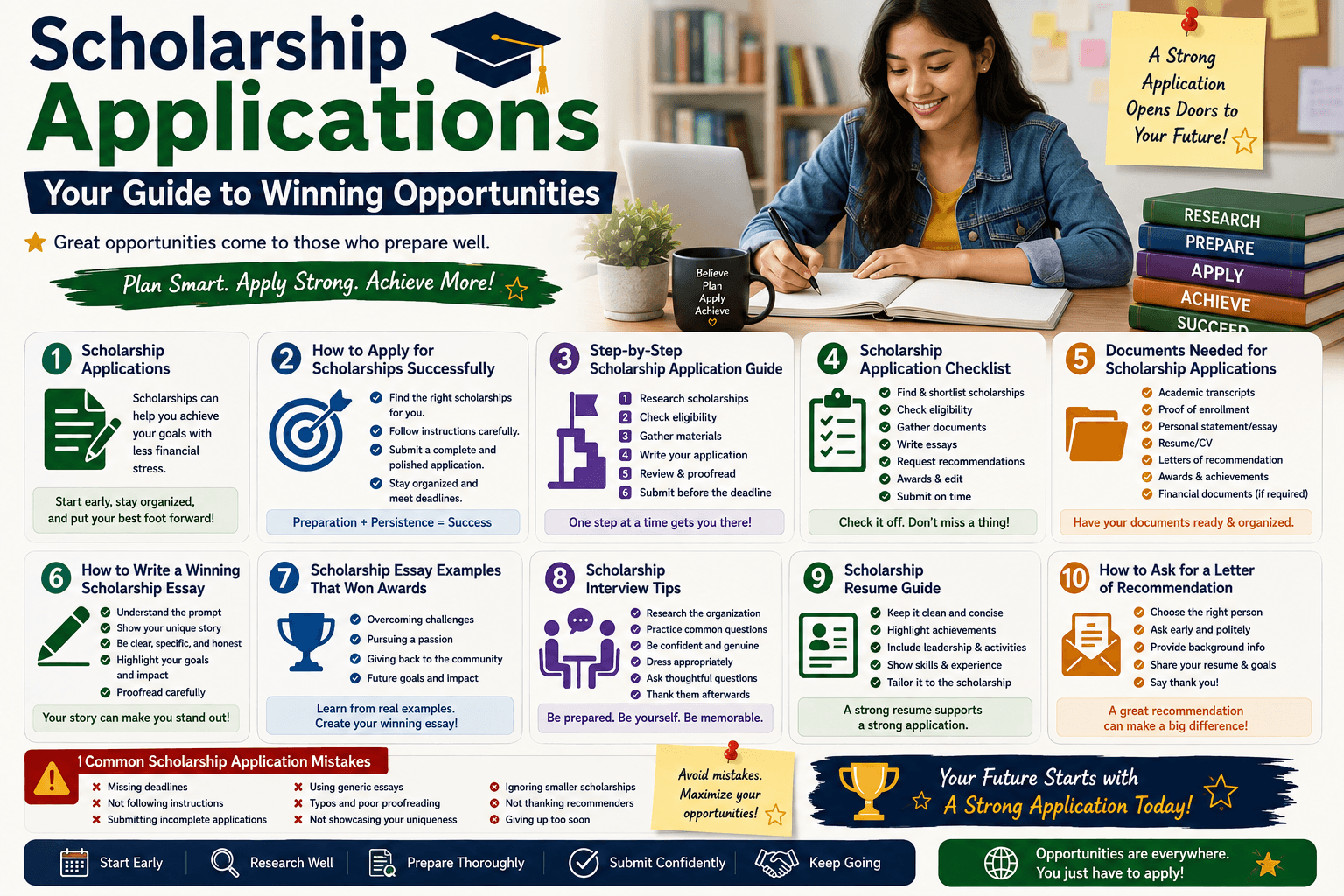
How to Apply for Scholarships Successfully
Success with scholarship applications rarely comes down to luck — it hinges on thorough prep work, attention to small details, and a deliberate strategy. The students who win the most scholarships aren’t necessarily the smartest — frequently, they’re just the applicants who submit the most applications and read the fine print.
A few core habits separate successful applicants from everyone else:
Get going long before due dates — applications thrown together at the last minute almost always show it.
Pay close attention to every instruction — missing a small detail, like a word count or file format, can disqualify an otherwise strong application.
Customize every submission — reviewers can almost always tell when an essay wasn’t written specifically for their program.
Submit to many programs at once — applying to more scholarships, including smaller local ones, significantly boosts your overall odds.
Step-by-Step Scholarship Application Guide
Here’s a simple, repeatable process to follow for nearly any scholarship:
Research and shortlist — build a list of eligible opportunities, weighting it toward programs that genuinely fit who you are.
Check requirements and deadlines — write down every requirement and deadline, then organize them somewhere easy to check.
Assemble your materials — academic records, references, income documents, and any other requested files.
Write your application essay — give yourself enough time to write multiple drafts, not just one rushed version.
Request recommendation letters — approach potential recommenders early, respecting their time and workload.
Polish the entire application — check for typos, formatting issues, and whether you’ve actually answered the prompt.
Send it in early, not at the last second — give yourself buffer time before the cutoff in case something goes wrong.
Send a thank-you note when relevant — acknowledging the people who supported your application is a small gesture that matters.
Scholarship Application Checklist
Use this rapid checklist right before you finalize anything:
Do you actually qualify based on every stated criterion?
Is your document set fully complete?
Has your essay been proofread by someone other than yourself?
Have your references actually turned in their letters?
Have you followed every formatting rule precisely — length limits, file format, required font?
Have you confirmed your email and phone number are current?
Have you submitted before the actual deadline, with buffer time to spare?
Documents Needed for Scholarship Applications
Most scholarships request a fairly predictable set of materials:
Academic transcripts — official records showing what you’ve studied and how you’ve performed.
A written essay — the section where you make your case — your background, ambitions, and motivations.
Letters of recommendation — written by teachers, mentors, employers, or coaches who know your work well.
List of achievements and activities — an overview of everything you’ve done — school, jobs, clubs, community service.
Proof of enrollment or acceptance — confirming you’re enrolled in, or accepted to, an eligible school or program.
Financial need documentation — tax returns, income statements, or aid forms like the FAFSA, when required.
How to Write a Winning Scholarship Essay
Among everything you submit, the essay tends to matter most — it’s your chance to stand out beyond grades and test scores.
What Makes an Essay Actually Win
Winning essays usually have several things in common:
A clear, specific story — specificity beats generality every time — one real story outperforms ten vague claims.
Authenticity over perfection — judges have seen every cliché in the book, so genuine voice stands out.
A clear connection to your goals — connect your story directly to your academic or career ambitions.
Multiple rounds of proofreading — typos and grammar mistakes signal carelessness, even if the content itself is strong.
Scholarship Essay Examples That Won Awards
While every winning essay is different, most successful ones follow a similar structure: they begin with a concrete scene or detail rather than a broad opening line. The essay then ties that moment to a broader insight, value, or personal shift. Finally, they tie everything back to the applicant’s future goals and why the scholarship matters.
Recurring subjects in strong essays involve resilience, meaningful mentorship, a turning-point experience, or a responsibility that shaped who the applicant became. It’s not about picking a dramatic topic — it’s about telling any topic with real honesty and detail.
Scholarship Interview Tips
Not every scholarship requires an interview, but for those that do, preparation matters enormously.
Review everything you submitted — expect follow-up questions on anything you wrote, so revisit your essay and resume beforehand.
Rehearse likely prompts — typical questions revolve around your goals, motivations, and reasons for applying.
Treat it like a real interview — treat every interview format with the same seriousness, video call or otherwise.
Show curiosity about the program — this shows genuine interest and helps you stand out from other candidates.
Scholarship Resume Guide
Unlike a professional resume, a scholarship resume has its own format — the focus shifts toward school achievements, community involvement, and leadership rather than paid work history.
Structure it cleanly, aim for a single page, and use clearly labeled sections for academics, extracurricular activities, volunteer work, awards, and skills. Lead with active language and include numbers whenever you can — specific verbs and specific numbers always beat vague descriptions.
How to Ask for a Letter of Recommendation
Requesting a reference doesn’t have to be stressful if you handle it thoughtfully.
Ask early — a month’s notice, if possible, respects their schedule and results in a stronger letter.
Ask the right person — someone who can speak to specific strengths or experiences, not just someone with a impressive title.
Provide context — send your resume, the scholarship description, and a few points you’d love them to mention.
Send a gentle reminder if needed — a short nudge close to the due date is normal and expected.
Say thank you — a sincere thank-you leaves a lasting, positive impression either way.
Common Scholarship Application Mistakes
Even strong candidates lose out due to avoidable errors. Watch out for these common pitfalls:
Missing deadlines — deadlines in scholarship applications are rarely, if ever, flexible.
Ignoring instructions — failing to follow exact formatting or content rules often results in automatic rejection.
Reusing the same essay for every application — reviewers can easily tell when an essay wasn’t tailored to their specific program.
Weak or rushed recommendation letters — last-minute requests often result in generic, unenthusiastic letters.
Submitting work full of typos — a single unedited draft rarely represents your best possible work.
Applying too narrowly — focusing only on large, highly competitive national awards while ignoring smaller local ones with better odds.
The Bottom Line for Beginners
More than anything, remember this — thorough preparation matters far more than a flawless application. Begin well ahead of deadlines, stick closely to every requirement, write honestly and specifically, and submit to every reasonable opportunity you find. Winning scholarships often comes down to persistence and effort as much as raw qualifications.